

Early Riders | Open Range Weekly | 04.05.26
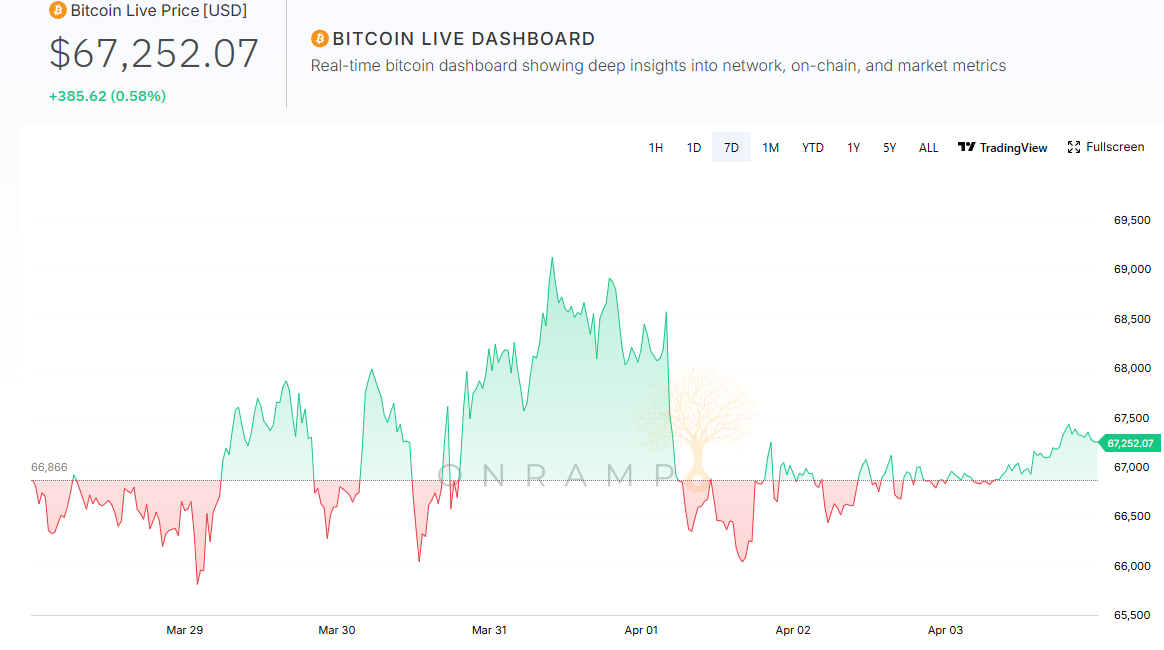
Bitcoin was up 0.5% this week to a market capitalization of $1.35T.
Early Riders Media
This week's podcast covered the macro fallout from the US-Iran conflict and the accelerating convergence of traditional finance and digital asset infrastructure, with Mastercard’s $1.8B acquisition of BVNK and the Clarity Act’s imminent legislative progress pointing toward a fundamental reshaping of how capital moves globally.
You can find all our episodes on our podcast website as well as listen on YouTube, Apple, and Spotify.
Industry & Institutional Updates
Square auto-enabled Bitcoin payments for ~4 million U.S. small businesses, converting transactions to dollars at checkout via the Lightning Network with zero processing fees.
Charles Schwab announced plans to launch direct spot Bitcoin and Ethereum trading for its 46 million clients in H1 2026 through new Schwab Crypto accounts.
The New Hampshire Business Finance Authority earned a Ba2 rating from Moody’s for a planned $100 million Bitcoin-backed municipal bond, the first of its kind, with CleanSpark providing Bitcoin collateral and BitGo as the custodian.
BitGo launched BitGo Mint, a native stablecoin minting and redemption platform for institutional clients.
Coinbase received conditional OCC approval for a national trust company charter, opening a path to federally chartered custody and stablecoin issuance.
CoinShares began trading on the Nasdaq via a $1.2 billion SPAC merger with Vine Hill Capital, becoming the first European digital asset manager to list on a major U.S. exchange.
Binance tested a prediction market feature inside its wallet app via a partnership with Predict.fun, allowing users to trade event outcomes across digital assets, sports, and economics.
Cross River raised $50 million from T. Rowe Price to expand its embedded finance platform across AI, digital assets, lending, and payments, powering infrastructure for over 100 fintech partners.
The Better Money Company closed a $10 million seed round, led by a16z’s digital asset practice, to build a stablecoin clearinghouse enabling cheap exchange between dollar-backed tokens.
Regulatory Updates
The Department of Labor proposed a safe harbor framework allowing 401(k) fiduciaries to include alternative assets including digital assets in retirement plans.
U.S. lawmakers released a draft of the Digital Asset PARITY Act offering a de minimis tax exemption for stablecoin transactions under $200, but omitting any equivalent exemption for Bitcoin transactions.
Dubai’s VARA published the first comprehensive regulatory framework for digital asset exchange-traded derivatives, requiring mandatory insurance funds for licensed providers.
Australia passed the Corporations Amendment (Digital Assets Framework) Bill, requiring crypto exchanges and custodians to obtain financial services licenses within six months under the same rules governing brokers and fund managers.
What We're Watching: Morgan Stanley Signals the Start of the Bitcoin-Banking Merger
Morgan Stanley filed to launch a spot Bitcoin ETF at 14 basis points. Instantly the lowest-cost product in a category that BlackRock's iShares Bitcoin Trust (iBit) has dominated since January 2024. The filing includes a full fee waiver on the first $5 billion in AUM, signaling this is a client acquisition play rather than a standalone revenue line. Morgan Stanley is the first bank-affiliated issuer to enter the spot bitcoin ETF market, and the implications of the fees and its stated moves extend to all banking products around bitcoin.
First Bank Issuer Shifts the Competitive Dynamic
Every spot Bitcoin ETF issuer to date including BlackRock, Fidelity, Invesco, and VanEck have been pure-play asset managers. These firms create products, collect management fees, and rely on third-party custodians (primarily Coinbase) for the underlying asset. The client relationship effectively ends at the fund wrapper. Morgan Stanley operates a fundamentally different model. With approximately $8 trillion in client-advised assets and roughly 16,000 financial advisors, the firm already maintains a formalized 0–4% Bitcoin allocation recommendation across client portfolios. Previously, those allocations flowed into third-party products (primarily iBit and Fidelity's FBTC); going forward, they flow internally. Management has been explicit that the ETF is designed to deepen existing client relationships rather than generate standalone fee revenue, which is strategically compelling given the firm's cross-selling infrastructure.
Beyond ETFs: Custody, Lending, and Structured Products
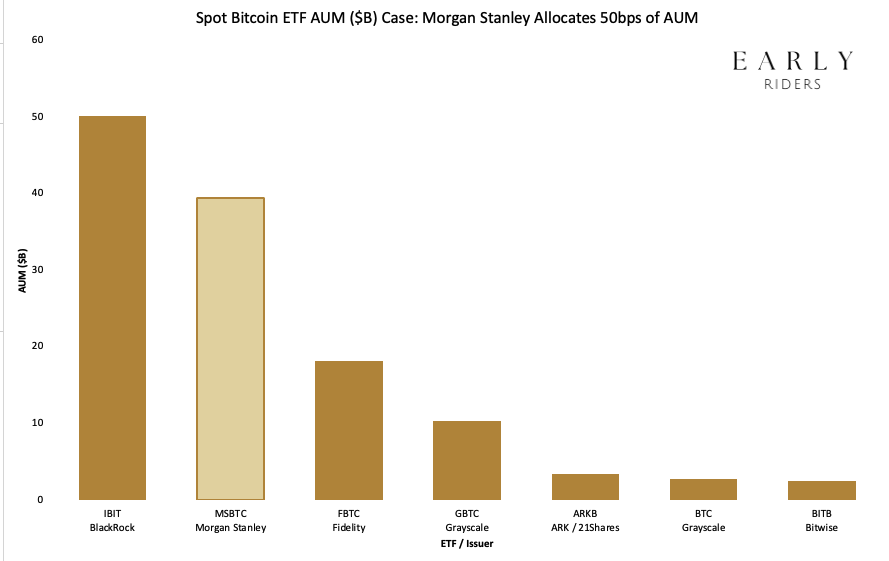
What separates this filing from the existing competitive set is the infrastructure buildout behind it. Morgan Stanley has publicly disclosed its intention to develop in-house Bitcoin custody and trade execution capabilities, a direct move to reduce dependence on Coinbase and one that mirrors the vertical integration logic we have observed across digital asset infrastructure companies (BitGo, Anchorage, Fireblocks). The firm's roadmap extends further: bitcoin-collateralized lending and structured notes with bitcoin exposure, and yield products offer higher-margin revenue than the ETF itself. The economics are not limited to the 14bps on the ETF, but will compound across the full platform ecosystem. If Morgan Stanley's client base allocated just 0.5% to Bitcoin through the fund, the resulting AUM would imply holdings almost $40B, and 80% of iBit holdings in year one. A 0.25% allocation would mean $20B and put MSBTC ahead of FBTC.
The Convergence Thesis in Practice
This move represents perhaps the clearest real-world validation of a thesis that has been building for over two years: the functional boundaries between crypto-native companies and traditional banking institutions are collapsing. When Morgan Stanley builds custody infrastructure, it will likely look like what digitally native firms have created, but have the benefit of built in distribution. Simultaneously, crypto-native infrastructure firms are moving in the opposite direction. BitGo obtained a federal bank charter. Coinbase launched institutional lending. Anchorage secured an OCC national trust charter. These are the same structural trends viewed from different entry points: Bitcoin is being integrated into the core plumbing of the American financial system.
The True Takeaways For Banking & Bitcoin
A bank managing $8 trillion in client assets does not build custody infrastructure for a transient trade, especially when the asset has retraced 50% from its peak. It does not waive fees on a product it expects to wind down and could be speculative noise. This is only their 7th ETF launched under their brand name to further enhance their suite of products for their customers.
At the same time, digitally native firms are increasingly launching banking-like services, including interest bearing accounts, credit products, structured products, and payments orchestration systems to utilize the trust and brand that they have built over time to offer better dollar based products to the customers where they have built trust over time. Some digitally native firms like Bitgo have even gotten banking charters, while others are looking to do the same.
Going forward, the space will likely get more competitive from both sides. Banks will increasingly offer digital asset products and services to cater to their existing customers who want to enter the digital asset market with a known brand and customer where there is a relationship. Meanwhile, digital asset firms will increasingly allow for customers to have their entire financial relationship, including storing all dollars and paying bills directly from one account.
Those who haven’t been paying attention to and building for this convergence will be left behind. Many banks who are behind in this transition will end up buying digital asset firms to optimize for speed to market and acquire trust from digitally native customers.
Chart of the Week
Morgan Stanley's spot Bitcoin ETF boasts the lowest fees on the market at only 14bps, which is 11bps lower than BlackRock's IBIT at 25bps. If just 50 basis points of Morgan Stanley's $8 trillion in AUM were allocated to MSBTC, total fund holdings would reach ~$40 billion, making it the second-largest spot Bitcoin ETF on the market, trailing only BlackRock's IBIT at nearly $50 billion.
Find this valuable? Please forward this to someone in your network who may find benefit from the information.
Early Riders is the first bitcoin-denominated venture firm, raising, holding, investing, and returning capital in bitcoin. Learn more about how to get involved www.earlyriders.com.
Make sure to keep up with all our research at earlyriders.com/research.