

Early Riders | Open Range Weekly | 04.12.26
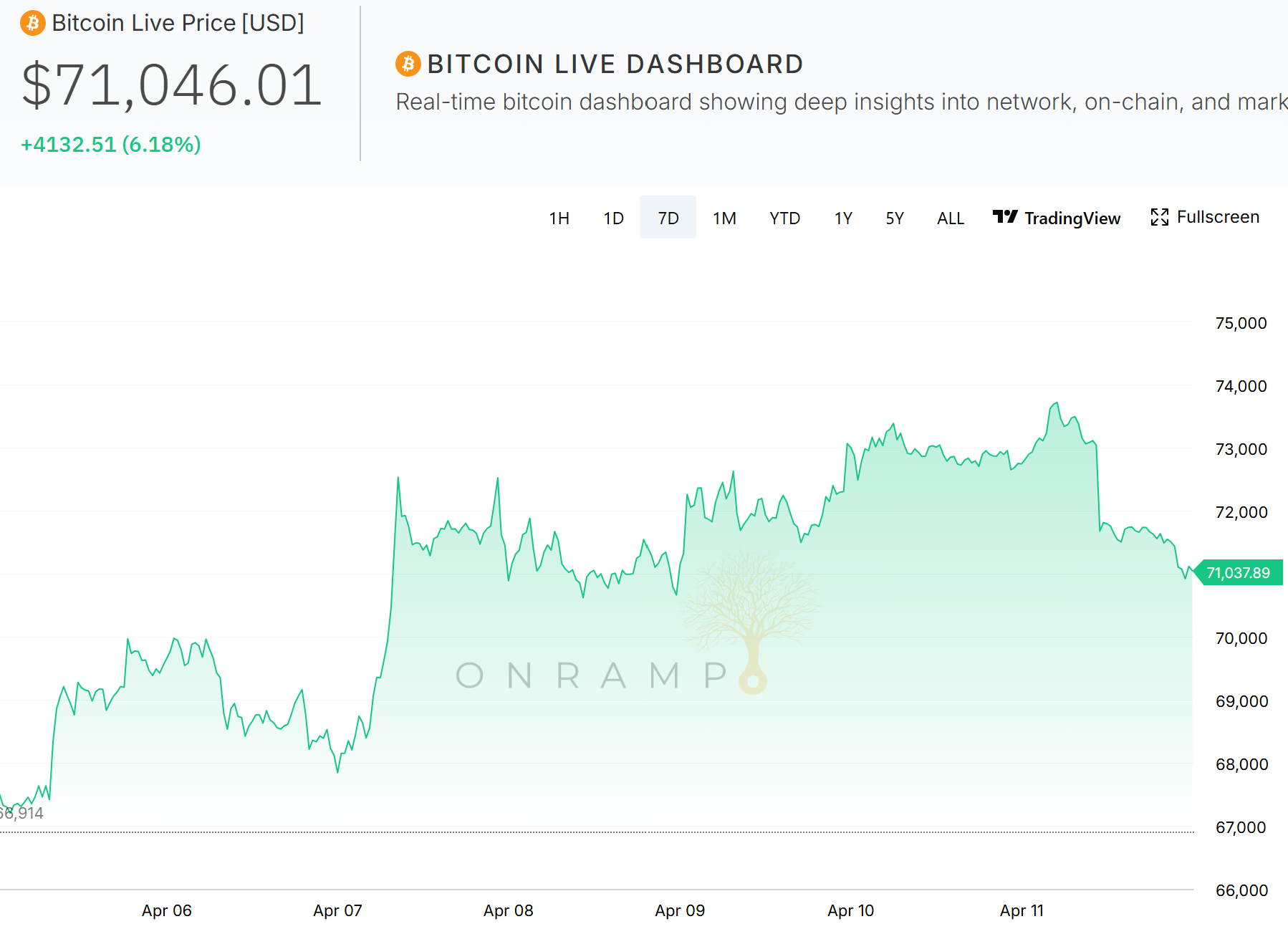
Bitcoin was up 6.1% this week to a market capitalization of $1.43T.
Early Riders Media
This week's podcast dissected the $280 million Drift DeFi hack and rising physical threats to digital asset holders, then shifted to TradFi's accelerating Bitcoin build-out, OpenAI's $100 million acquisition of TBPN, and AI's structural compression of corporate headcount.
You can find all our episodes on our podcast website as well as listen on YouTube, Apple, and Spotify.
Industry & Institutional Updates
Morgan Stanley officially launched its spot Bitcoin ETF on April 8, drawing $34 million in day-one inflows, making it the firm's most successful ETF launch on day one.
Potential buyers evaluated acquiring select assets from Gemini, the Winklevoss-backed digital asset exchange, reflecting continued consolidation pressure on mid-tier platforms.
Charles Schwab announced plans to launch spot Bitcoin and Ethereum trading in the first half of 2026, opening a waitlist for its new Schwab Crypto account.
Strategy resumed Bitcoin treasury purchases, acquiring 4,871 BTC for $330 million in early April at an average price of $67,718 per coin, bringing total holdings to roughly 766,970 BTC.
Standard Chartered is weighing a restructuring that would fold the firm’s custody operations business into its corporate banking division while keeping the subsidiary running standalone, with Bloomberg reporting an announcement could come as early as this month.
Regulatory & Sovereign Updates
The FDIC approved a proposal to implement GENIUS Act stablecoin standards, requiring 1:1 reserve assets, two-business-day redemptions, and tailored capital requirements for permitted payment stablecoin issuers.
Treasury Secretary Scott Bessent called on Congress to pass the Clarity Act in a Wall Street Journal op-ed, arguing that clear digital asset regulation is necessary to maintain U.S. leadership.
Iran is requesting digital asset toll payments for the Strait of Hormuz, accepting Bitcoin and USDT from oil tankers at up to $2 million per vessel.
South Korea's ruling party introduced a draft Digital Asset Act classifying stablecoins as payment instruments under its Foreign Exchange Transactions Act and requiring RWA issuers to hold underlying assets in managed trusts.
What We're Watching: How Artificial Intelligence Is Restructuring the Firm
Executive Summary:
Corporate hierarchy has always been an information routing system. Every middle management layer ever built exists to relay context up and down a chain of command. For the first time in two thousand years, AI can replace that function entirely.
This shift is already occurring in the corporate environment, but some firms are innovating more efficiently than others. U.S. labor productivity grew 2.7% in 2025, which is nearly double the prior decade's average. AI task-completion has increased roughly 10,000x since 2019. Block cut 40% of its workforce while its gross profit grew 24%. Oracle eliminated 18% of its global headcount to fund a $50 billion AI infrastructure buildout.
The deeper pattern behind these numbers is that most companies are using AI to optimize existing processes, pointing it at the same machine and running it slightly cheaper. The companies pulling away are using it to eliminate the approval layers and management tiers that have always stood between an idea and its execution. This is the organizational root of the innovator's dilemma, and AI is the first technology capable of dissolving it.
AI Adoption: Strong on Paper, Weak on Implementation
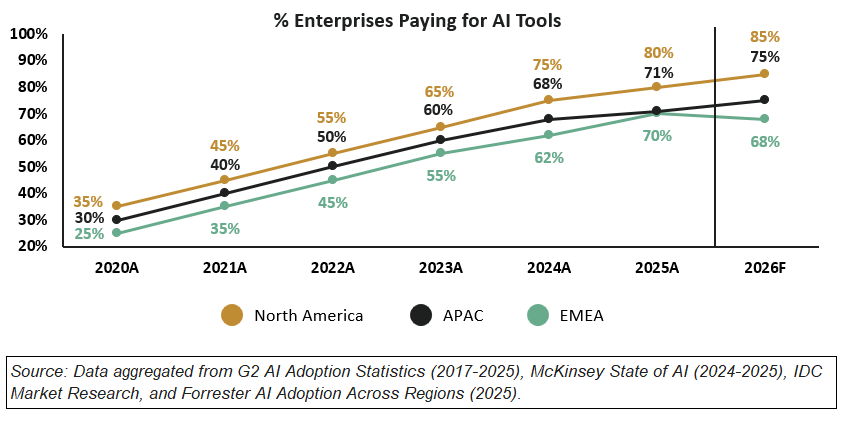
A recent report, published by McKinsey last year, showed that around 85% of enterprises in North America are using AI today, which is an increase of ~10% from the beginning of 2025. However, according to Deloitte's State of AI in the Enterprise survey, only 1% of respondents say AI has been fully scaled across their organizations. Almost 80% are still in testing or minimal to no usage, without a clear path to large-scale adoption.
McKinsey's own experience illustrates the gap precisely. The firm reported that 72% of its roughly 45,000 employees had access to its internal Lilli AI platform prior to being hacked. Lilli is trained on decades of McKinsey's proprietary strategy and case data, giving it an institutional knowledge base that most firms could never replicate. Yet, Lilli still only processed around 500,000 prompts per month, which is about ten prompts per employee. By that measure, even one of the world's most sophisticated consulting firms, with arguably one of the most valuable AI platforms in existence, is using AI at a level that most would describe as light experimentation.
Productivity Evidence: What the Data Actually Shows
U.S. labor productivity grew approximately 2.7% in 2025, nearly double the 1.4% annual average of the prior decade. Stanford researchers describe this as the point the investment in adoption begins to compound into measurable output gains.
Customer service and knowledge: A Stanford and MIT study (NBER Working Paper 31161) tracking customer service agents found AI boosted overall productivity by 14%, with the least experienced workers seeing a 35% increase in issues resolved per hour. Requests to speak to a manager dropped 25%. A Harvard and Stanford study in 2025, found that AI helped marketing specialists and software developers perform tasks at a level comparable to more senior web analysts; this demonstrates that AI raises the performance floor, not just the ceiling.
Software development: GitHub data shows developers using Copilot reduced the average time to open a pull request from 9.6 days to 2.4 days, with an 84% increase in successful builds. GitHub Copilot now generates 46% of code written by developers on the platform. The AI coding tools market stands at $7.37 billion and is expanding as agentic coding capabilities accelerate.
The Capability Curve: From Seconds to Hours:
The most precise measure of AI's productivity trajectory comes from METR (Model Evaluation and Threat Research), a nonprofit that has systematically tracked a metric called "task-completion time horizon" across every major frontier model since 2019. The time horizon is the length of a task, which is measured by how long it takes a skilled human expert to complete, at which an AI agent succeeds with 50% reliability. It is the cleanest available measure of how much autonomous cognitive work AI can reliably manage.
The 7-year progression has been unprecedented:
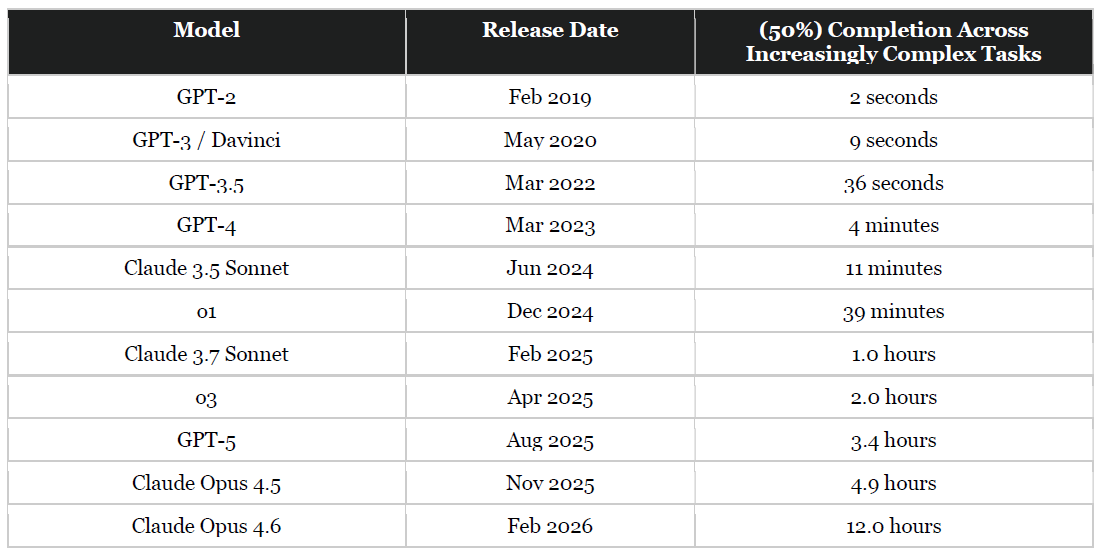
From 2 seconds (GPT-2, 2019) to 12 hours (Claude Opus 4.6, February 2026), that is a roughly 10,000x increase in task complexity capability in just seven years. METR calculates the doubling time for this metric at approximately 129 days since 2023, meaning AI task-completion capability has been doubling almost every four months.
Conclusion:
The AI labor compression thesis is not about a future state. It is about a structural shift already visible in earnings reports, workforce announcements, and company performance data across every major industry. The companies moving first are doing so from strength. The Early Riders fund was built on the observation that the most durable businesses are those that do more with less and hold the resulting surplus in a scarce asset. AI makes the "do more with less" leg executable at a speed and scale no prior technology has enabled. Bitcoin makes the savings leg structurally superior to every dollar-denominated alternative. The venture stage is where both legs are cheapest to acquire and where the compounding over the life of a fund is the most dramatic.
Our latest research piece outlines why we believe a broad wave of enterprise-level restructurings is coming faster than most expect.
Chart of the Week
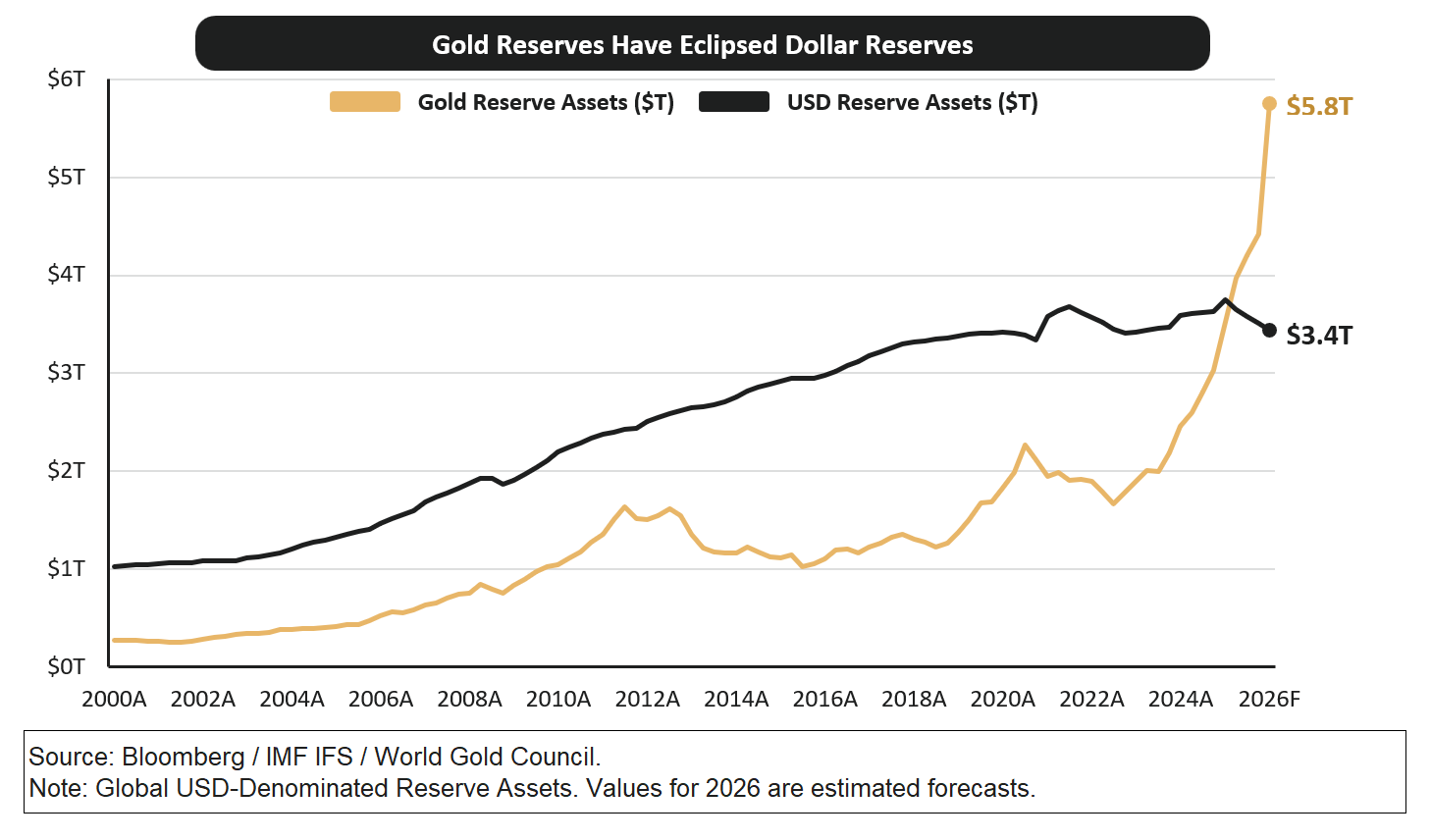
Global gold reserve assets have surpassed dollar-denominated reserves for the first time since 2000, reaching an estimated $5.8 trillion versus $3.4 trillion in USD reserves. The crossover reflects a structural shift in how central banks are managing sovereign balance sheets: as confidence in dollar-denominated assets erodes amid persistent fiscal deficits, sanctions risk, and geopolitical fragmentation, gold has re-emerged as the preferred neutral reserve asset.
Find this valuable? Please forward this to someone in your network who may find benefit from the information.
Early Riders is the first bitcoin-denominated venture firm, raising, holding, investing, and returning capital in bitcoin. Learn more about how to get involved www.earlyriders.com.
Make sure to keep up with all our research at earlyriders.com/research.