

Early Riders | Open Range Weekly | 04.19.26
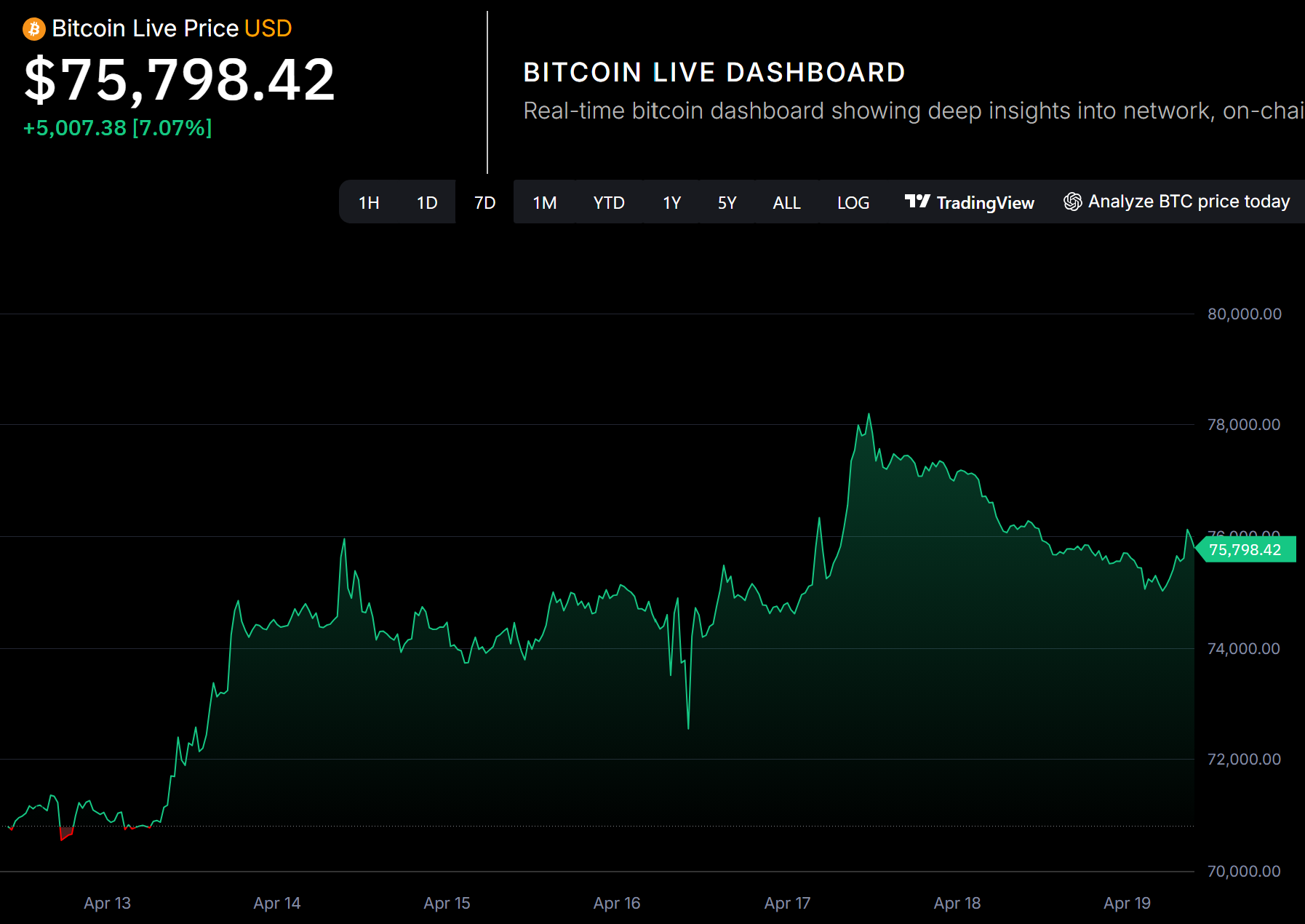
Bitcoin was up 7.1% this week to a market capitalization of $1.52T.
Early Riders Media
This week's podcast examined how Iran's military is accepting Bitcoin and stablecoins for passage through the Strait of Hormuz, Morgan Stanley's spot Bitcoin ETF launch and its long-term distribution strategy, and Treasury Secretary Bessent's Wall Street Journal op-ed framing the CLARITY Act as a national security priority.
You can find all our episodes on our podcast website as well as listen on YouTube, Apple, and Spotify.
Industry & Institutional Updates
Kraken co-CEO Arjun Sethi confirmed the company's confidential S-1 IPO filing remains active, despite a valuation decline from $20B to $13.3B.
Payward, Kraken’s parent company, agreed to acquire Bitnomial for up to $550M, securing a full CFTC-licensed derivatives stack including exchange, clearinghouse, and FCM.
Charles Schwab announced Schwab Crypto, a phased spot Bitcoin and Ethereum trading rollout for retail clients through a partnership with Paxos.
Fireblocks launched Earn, giving institutional clients native stablecoin yield access through Aave and Morpho Vaults within the Fireblocks platform.
Michael Saylor's Strategy acquired 13,927 BTC for ~$1B, pushing the firm's total holdings to 780,897 BTC.
Goldman Sachs filed with the SEC to launch a Bitcoin Premium Income ETF using a covered-call strategy to generate yield on Bitcoin-linked holdings.
Tether launched tether.wallet, a self-custodial wallet supporting USDT, gold, and Bitcoin, targeting the 570 million users already on Tether's global infrastructure.
Slash Financial raised $100M at a $1.4B valuation in a Series C led by Ribbit Capital and Khosla, with the profitable business banking and crypto platform reporting $300M in annualized revenue and over 5,000 customers.
Six Swiss banks including UBS launched a Swiss franc stablecoin sandbox on Ethereum to test payment flows and programmable settlement.
Securitize appointed former SEC Trading and Markets director Brett Redfearn as president ahead of its Cantor Fitzgerald SPAC merger.
Regulatory & Sovereign Updates
Japan's cabinet approved an amendment classifying crypto as financial instruments on par with stocks and bonds, adding insider trading bans and mandatory disclosures.
Tennessee's Strategic Bitcoin Reserve Act advanced to the Senate Finance Committee with a hearing set for April 20, authorizing up to 10% of select state funds to be allocated to Bitcoin.
France's central bank deputy governor called for stricter MiCA limits on dollar stablecoin payments, while the National Assembly passed a bill requiring annual declarations for self-custodied wallets over €5,000.
Pakistan's State Bank authorized banks to open accounts for licensed digital asset firms, ending a seven-year ban that barred regulated entities from dealing in virtual assets.
What We're Watching: Charles Schwab Launches Spot Bitcoin Trading
Charles Schwab revealed the details behind their plans for bitcoin and ether trading this week. The company plans to partner with Paxos for trading and sub-custody, for their planned Q2 release.
The company plans to offer trading at 75bps, and will not allow for in-kind deposit or withdrawals for the initial version of the product, although they mention this as being on their roadmap.
Early Riders has long held the thesis that all exchanges and banks will offer bitcoin products within the next few years, although primarily through partnerships and acquisitions. They have the benefit of distribution and trust, which should bring more customers into the ecosystem for the first time.
However, the offering is clearly subpar for any sophisticated client. The trading fees that Schwab passes along to clients is on top of the spread and execution costs of Paxos. Not allowing deposits and withdrawals in kind is sub optimal for someone who wants to ensure that they can maintain their bitcoin in any future use case.
Using a single sub custodian outsources client custody risk and introduces single points of failure.
Meanwhile, on the other side, we are continually seeing digital asset exchanges acting more like banks. Digital asset native firms are increasingly offering higher yielding dollar balances, bill pay, payment options, loans and credit cards to build on the trust they have generated and allow customers simplicity from interactions.
Every company is going to increase their product suite in the future, as the cost of building in house continues to rapidly fall, customers request single locations to access their financial lives, and competition causes fast follow product development cycles.
The line between banking, exchange, fintech, and digital asset native companies will continue to blur, with massive value accruing to those with differentiated products, brand distribution & trust. However, the consumer will benefit the most, as better bitcoin and banking like services are coming.

Chart of the Week
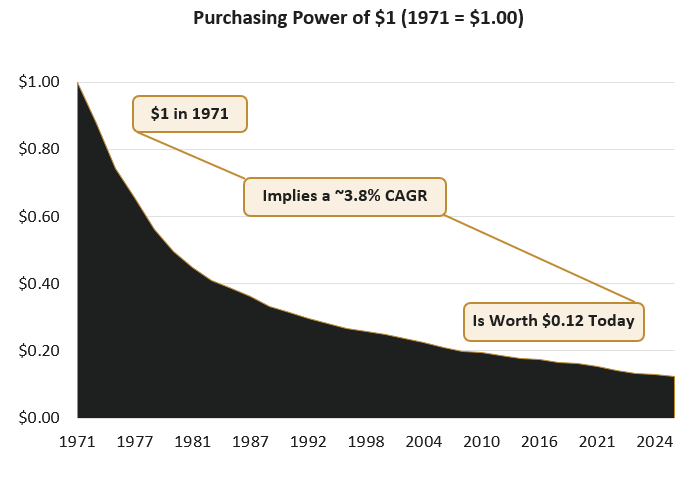
1971 ended the gold standard. Since 1971, the purchasing power of $1 has eroded to just $0.12, a ~3.8% annualized decline that has quietly stripped away nearly 88% of the dollar's value. The end of the gold standard removed the last hard constraint on money printing, and inflation has been relentless ever since.
Early Riders is the first bitcoin-denominated venture firm, raising, holding, investing, and returning capital in bitcoin. Learn more about how to get involved www.earlyriders.com.
Make sure to keep up with all our research at earlyriders.com/research.