

How Artificial Intelligence Is Restructuring the Firm
Link to the full Research in PDF
Executive Summary:
Corporate hierarchy has always been an information routing system. Every middle management layer ever built exists to relay context up and down a chain of command. For the first time in two thousand years, AI can replace that function entirely.
This shift is already occurring in the corporate environment, but some firms are innovating more efficiently than others. U.S. labor productivity grew 2.7% in 2025, which is nearly double the prior decade's average. AI task-completion has increased roughly 10,000x since 2019. Block cut 40% of its workforce while its gross profit grew 24%. Oracle eliminated 18% of its global headcount to fund a $50 billion AI infrastructure buildout.
The deeper pattern behind these numbers is that most companies are using AI to optimize existing processes, pointing it at the same machine and running it slightly cheaper. The companies pulling away are using it to eliminate the approval layers and management tiers that have always stood between an idea and its execution. This is the organizational root of the innovator's dilemma, and AI is the first technology capable of dissolving it.
AI Adoption: Strong on Paper, Weak on Implementation
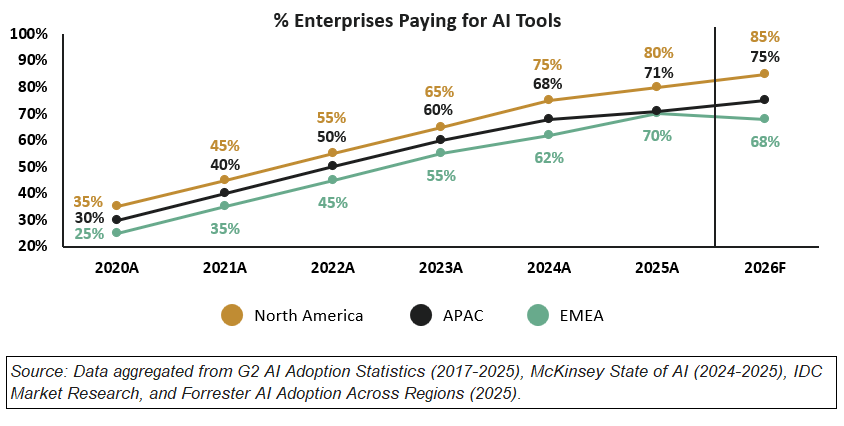
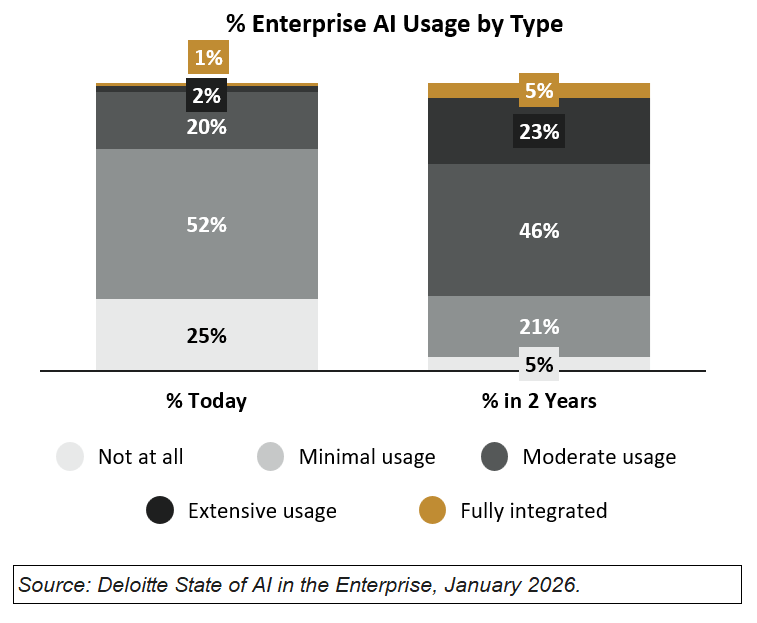
A recent report, published by McKinsey last year, showed that around 85% of enterprises in North America are using AI today, which is an increase of ~10% from the beginning of 2025. However, according to Deloitte’s State of AI in the Enterprise survey, only 1% of respondents say AI has been fully scaled across their organizations. Almost 80% are still in testing or minimal to no usage, without a clear path to large-scale adoption.
Productivity Evidence: What the Data Actually Shows
U.S. labor productivity grew approximately 2.7% in 2025, nearly double the 1.4% annual average of the prior decade. Stanford researchers describe this as the point the investment in adoption begins to compound into measurable output gains.
Customer service and knowledge: A Stanford and MIT study (NBER Working Paper 31161) tracking customer service agents found AI boosted overall productivity by 14%, with the least experienced workers seeing a 35% increase in issues resolved per hour. Requests to speak to a manager dropped 25%. A Harvard and Stanford study in 2025, found that AI helped marketing specialists and software developers perform tasks at a level comparable to more senior web analysts; this demonstrates that AI raises the performance floor, not just the ceiling.
Software development: GitHub data shows developers using Copilot reduced the average time to open a pull request from 9.6 days to 2.4 days, with an 84% increase in successful builds. GitHub Copilot now generates 46% of code written by developers on the platform. The AI coding tools market stands at $7.37 billion and is expanding as agentic coding capabilities accelerate.
The Capability Curve: From Seconds to Hours:
The most precise measure of AI's productivity trajectory comes from METR (Model Evaluation and Threat Research), a nonprofit that has systematically tracked a metric called "task-completion time horizon" across every major frontier model since 2019. The time horizon is the length of a task, which is measured by how long it takes a skilled human expert to complete, at which an AI agent succeeds with 50% reliability. It is the cleanest available measure of how much autonomous cognitive work AI can reliably manage.
The 7-year progression has been unprecedented:
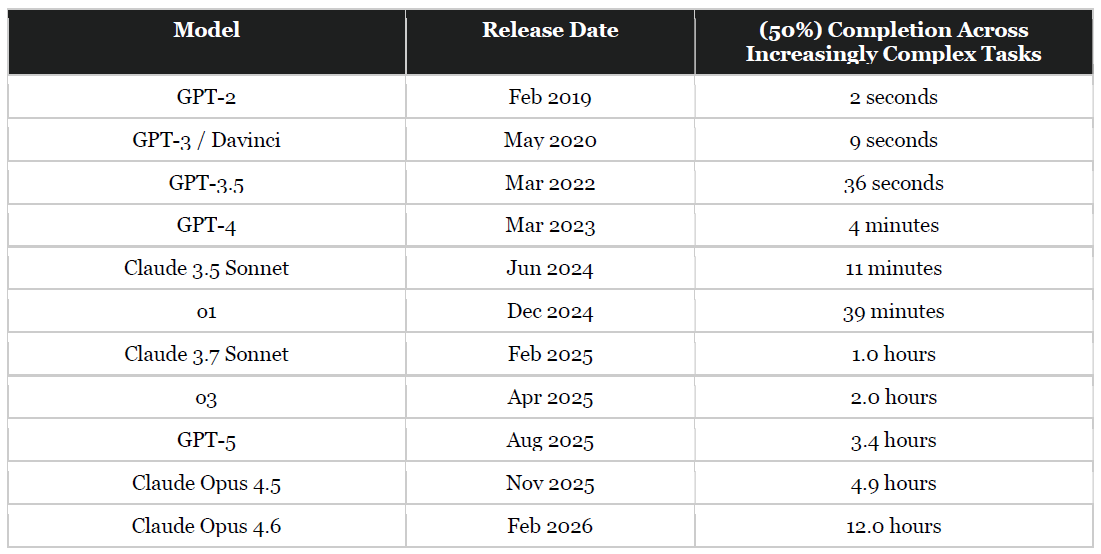
From 2 seconds (GPT-2, 2019) to 12 hours (Claude Opus 4.6, February 2026), that is a roughly 10,000x increase in task complexity capability in just seven years. METR calculates the doubling time for this metric at approximately 129 days since 2023, meaning AI task-completion capability has been doubling almost every four months.
The Speed Multiplier:
The time horizon metric understates actual productivity gains for a structural reason: AI agents complete tasks significantly faster than the human baseline they are measured against. On tasks they successfully complete, AI agents are typically several times faster than skilled professionals. METR identifies three reinforcing efficiency factors: AI often writes working code in a single pass rather than iterating and debugging; it maintains full task context without switching costs; and it can explore multiple solution paths simultaneously. A task that takes a human expert two hours to complete may take a capable AI agent just 20 to 30 minutes.
The largest gains accrue to less experienced workers and high-volume repetitive cognitive tasks. Senior workers and complex judgment calls see smaller improvements as these types of workflows often still require “creative” or “out of the box thinking,” which will remain as one of AI’s weakest areas. AI raises the floor of individual output; this is precisely why it compresses headcount. When the productivity floor rises, you need fewer people to reach the same output threshold. Meanwhile, every incremental AI-fluent head that is added generates exponentially more output.
What the Gains Actually Look Like:
The productivity gains documented above are significant. For software teams where Copilot has reduced pull request timelines by 75%, the compounding effect on delivery speed and engineering capacity is even more pronounced. At the macroeconomic level, Goldman Sachs estimates that widespread AI adoption could raise global GDP by approximately 7% over a ten-year period, representing roughly $7 trillion in additional economic output. McKinsey’s analysis suggests AI could add between $2.6 and $4.4 trillion annually to the global economy through productivity improvements alone.
Conclusion:
The AI labor compression thesis is not about a future state. It is about a structural shift already visible in earnings reports, workforce announcements, and company performance data across every major industry. The companies moving first are doing so from strength. The Early Riders fund was built on the observation that the most durable businesses are those that do more with less and hold the resulting surplus in a scarce asset. AI makes the "do more with less" leg executable at a speed and scale no prior technology has enabled. bitcoin makes the savings leg structurally superior to every dollar-denominated alternative. The venture stage is where both legs are cheapest to acquire and where the compounding over the life of a fund is the most dramatic.
To learn more, the full article is available here:
Early Riders is the first bitcoin-denominated venture firm, raising, holding, investing, and returning capital in bitcoin. Learn more about how to get involved www.earlyriders.com.
Make sure to keep up with all our research at earlyriders.com/research.