

Early Riders | Open Range Weekly | 05.17.26
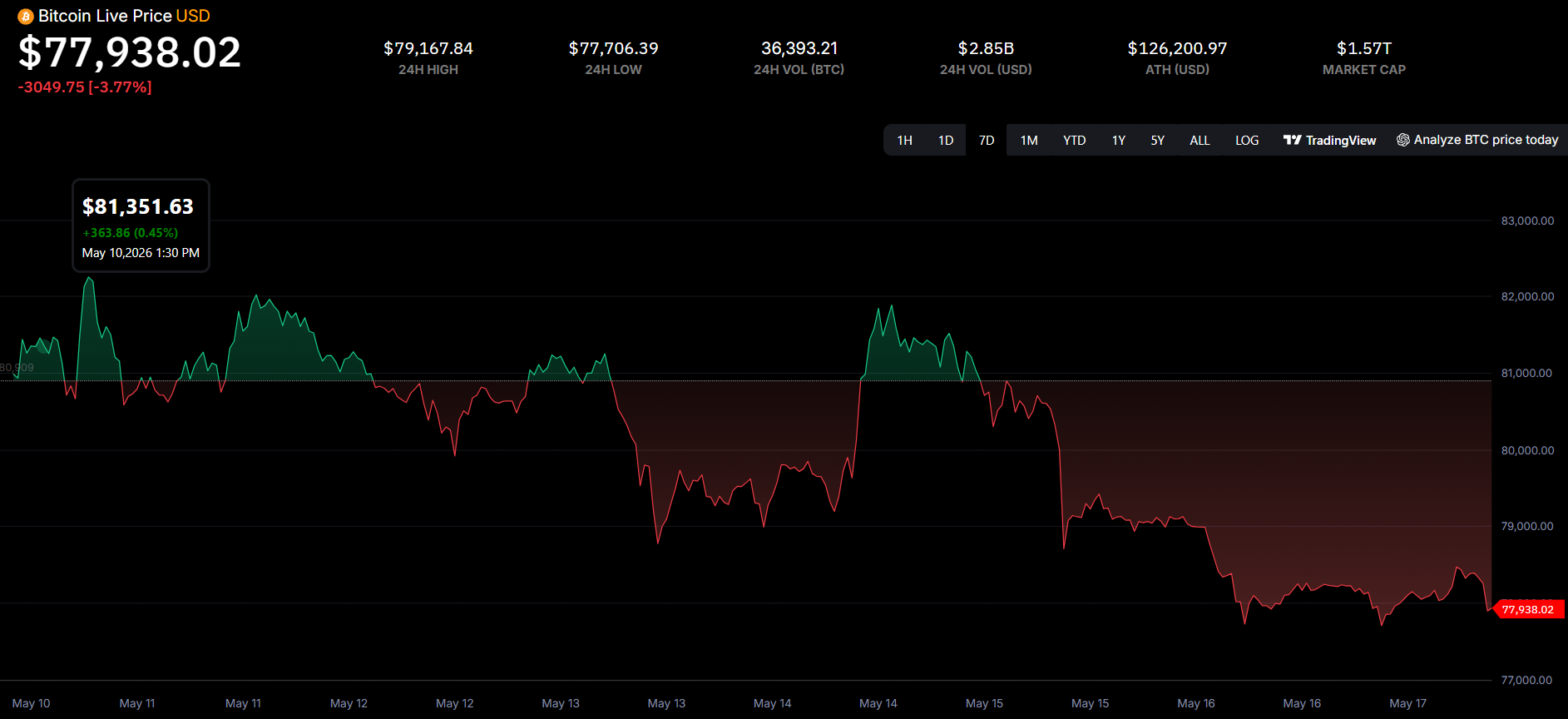
Bitcoin was down (3.8%) this week to a market capitalization of $1.57T
Early Riders Media
On this week's podcast, the team dissected Coinbase's rough quarter, including a five-hour outage and fee compression from Hyperliquid and E-Trade, then turned to the Clarity Act's path to passage amid fierce banking lobby opposition, and closed on the growing wave of Bitcoin financialization through tokenized securities, BNY Mellon's Abu Dhabi custody launch, and Kraken's $600 million acquisition of REAP.
You can find all our episodes on our podcast website as well as listen on YouTube, Apple, and Spotify.
Industry & Institutional Updates
Onramp raised a $12.5 million Series A at a $135 million valuation led by Early Riders, deploying capital to scale Onramp's Finance platform and to further build out the firm's Multi-Institution Custody infrastructure globally.
Morgan Stanley's MSBT recorded zero net outflow days in its first 30 days of trading, pulling in $194 million while rival ETFs from BlackRock, Fidelity, and ARK all posted outflows.
JPMorgan increased its BlackRock IBIT stake by 174% in Q1 2026 to 8.3 million shares, adding roughly $162 million.
Charles Schwab launched spot Bitcoin and Ether trading for U.S. retail clients at a fee of 75 basis points, marking the $12 trillion brokerage's formal entry into digital assets.
Mubadala disclosed a $566 million position in BlackRock's IBIT as of March 31, a 16% increase in shares from its prior filing, marking continued sovereign accumulation of Bitcoin exposure by Abu Dhabi's state investment fund.
BitGo reported Q1 2026 revenue up 112.6% year-over-year with Stablecoin-as-a-Service growing 44% sequentially to $38 million, but posted a net loss of $60.7 million, widening from $25.7 million a year earlier.
Gemini reported Q1 revenue up 42% year-over-year but posted a net loss of $109 million as operating expenses surged 73% to $144.5 million, with founders injecting a $100 million private placement to shore up a balance sheet burning through cash.
Circle raised $222 million at a $3 billion valuation for its Arc blockchain, backed by BlackRock, Apollo, and a16z.
Braiins acquired CAMMS Capital, a CFTC-registered commodity asset management firm, to apply commodity-grade risk management tools to Bitcoin mining and energy markets.
Kakao sold a $670 million stake in Upbit's parent Dunamu, South Korea's largest digital asset exchange, to Hana Bank.
Elliptic raised $120 million in a Series D led by One Peak, to expand its AI-native digital asset compliance platform.
Payward (Kraken) announced a strategic collaboration with Franklin Templeton to develop on-chain investment products including tokenized yield, equities, and BENJI money market fund integration.
Payward (Kraken) targeted a $20 billion valuation in a new funding push, signaling renewed investor appetite for large-scale crypto infrastructure firms with diversified institutional product offerings.
Crypto.com received the UAE's first VASP-held Stored Value Facilities license, enabling digital asset payments for Dubai government services.
Turnkey raised $12.5 million led by Archetype and Circle Ventures, alongside Bain Capital Crypto, Lightspeed Faction, Galaxy Ventures, Sequoia, and Variant, to scale verifiable cloud infrastructure for embedded crypto wallets and on-chain automation.
Corpay partnered with BVNK to embed stablecoin wallets and always-on settlement rails across its 800,000+ global corporate clients.
MEXC expanded its Guardian Fund from $100 million to $500 million and acquired 1,000 Bitcoin for a dual-reserve structure, with all holdings traceable on-chain.
Ledger paused their U.S. IPO plans amid weak digital asset market conditions and declining investor appetite for new listings.
Regulatory & Sovereign Updates
Kevin Warsh won Senate confirmation as Federal Reserve Chair in a 54-45 vote, the most partisan Fed confirmation in modern history.
The Senate Banking Committee advanced the Clarity Act 15-9, sending digital asset market structure legislation to a full Senate floor vote.
The American Bankers Association mobilized thousands of bank CEOs to lobby senators against the Clarity Act's stablecoin yield provisions, calling them a backdoor interest loophole.
Australia proposed replacing its 50% long-term capital gains discount with an inflation-indexed model, significantly raising taxes on digital asset gains.
South Korea passed amendments requiring companies handling overseas digital asset transfers to register with the Ministry of Economy and Finance.
North Korean hackers stole $577 million across two 2026 attacks, representing 76% of all digital asset industry hack losses through April.
What We're Watching: Our Second Bet on Bitcoin's Infrastructure Layer
This week, we announced our second lead investment into Onramp via the firm's Series A investment round.
To learn more about Onramp and our full thesis behind the investment, you can view the full investment memo here.
The Constraint Is Not Demand
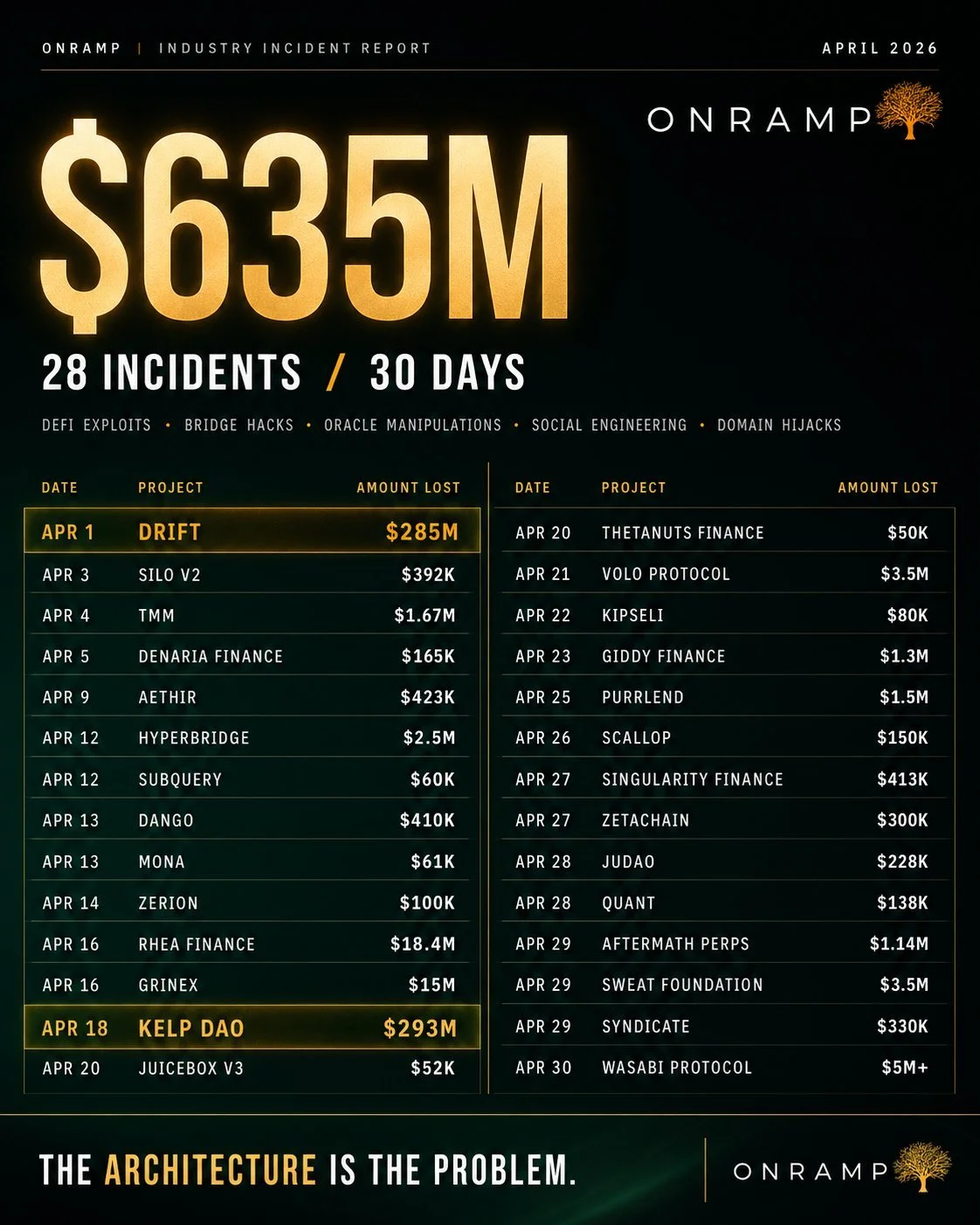
In April 2026 alone, $635 million disappeared across 28 separate incidents in just 30 days. DeFi exploits, bridge hacks, oracle manipulations, social engineering, domain hijacks, and more, have plagued the industry for over a decade, and they are only becoming more common as the value of bitcoin rises. Additionally, the attack vector changes almost monthly. However, the underlying cause does not: the architecture is the problem. Spot ETFs have crossed $100 billion in AUM and major wirehouses are offering bitcoin trading, while adoption is accelerating across corporates, endowments, and sovereigns. Bitcoin has not gone mainstream because of custody, not demand.
The Architecture No One Else Has Built
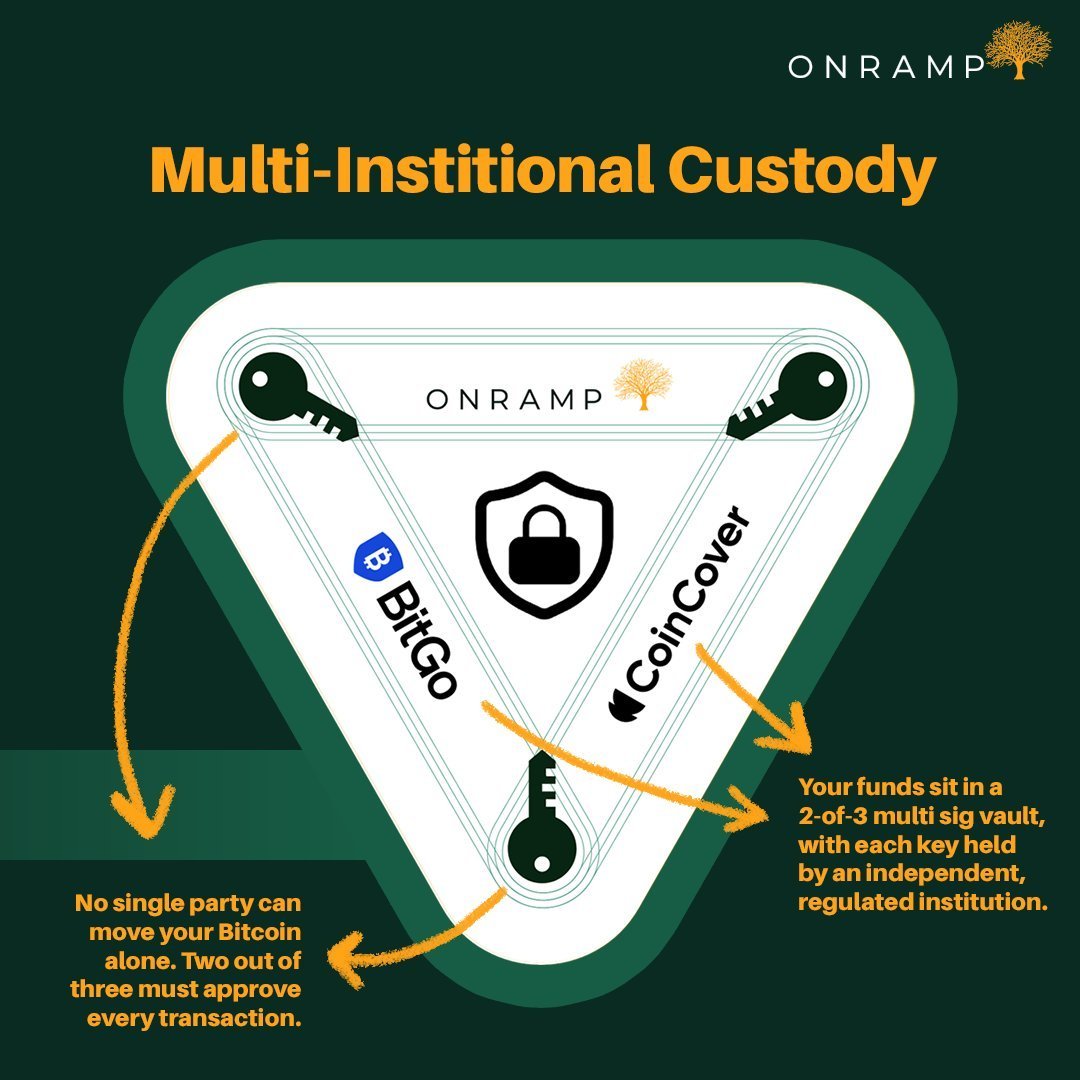
Onramp's solution is Multi-Institution Custody (MIC): private key control distributed across multiple independent and regulated custodians using bitcoin-native multisig with quorum-based signing. If any single institution is compromised, assets remain fully safe and accessible. With Onramp's infrastructure, there is no single point of failure. It is the first custody architecture that actually honors bitcoin's own design principles.
The Proof Is in the Performance
Onramp has crossed $1 billion in assets under custody with just 12 employees and zero security incidents since inception. The firm custodies over $83 million in bitcoin per employee, which is five to ten times the capital efficiency of legacy firms such as BNY Mellon or State Street. The validation speaks for itself as The Bitcoin Policy Institute has endorsed MIC as the preferred custody method for state Strategic Bitcoin Reserves and Cartwright, the first UK pension fund to allocate to bitcoin, selected Onramp as its custodian. These are institutional endorsements of a genuinely differentiated model.
Custody Is the Wedge
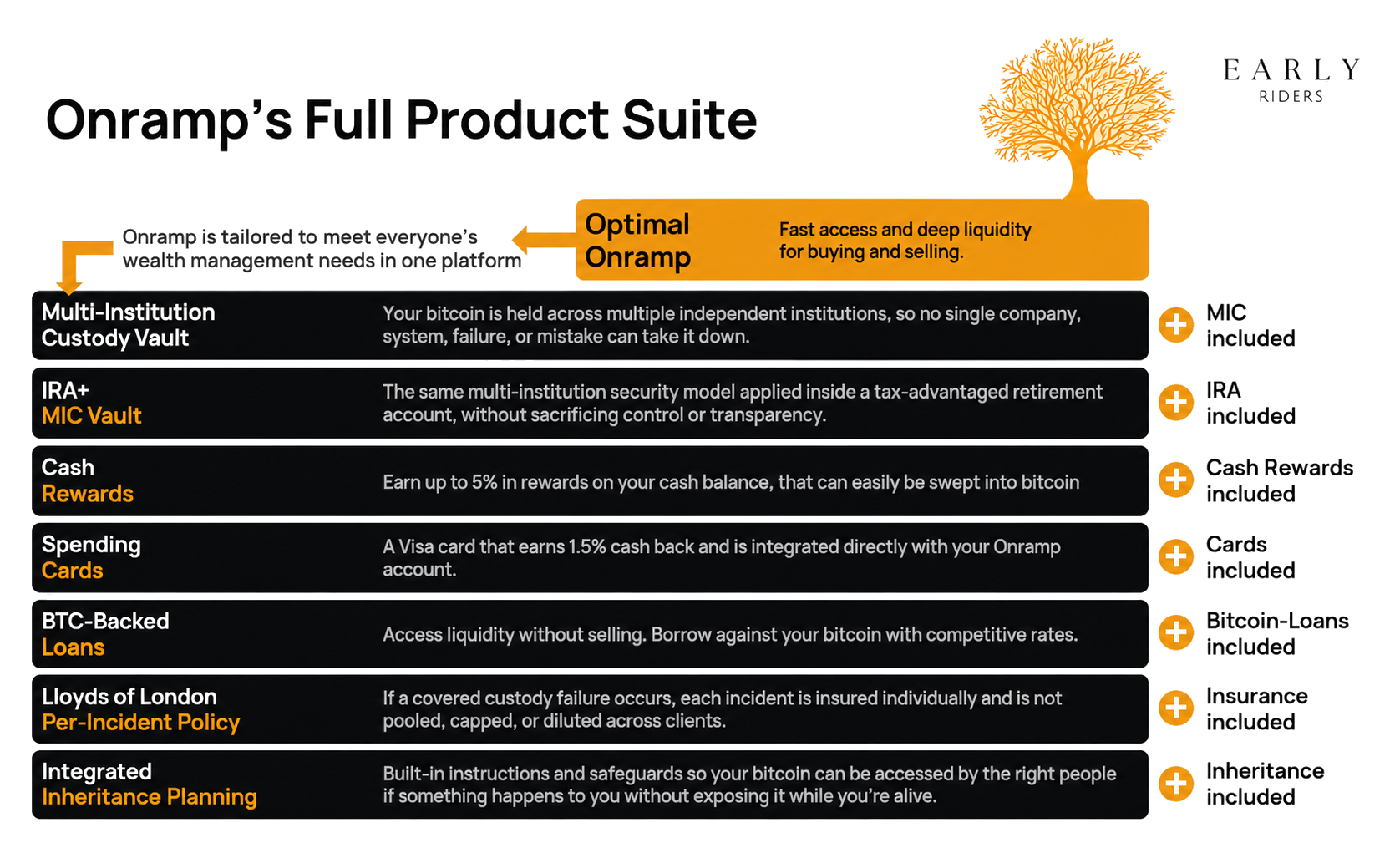
The financial services stack built on top, which includes trading, lending, credit, IRAs, inheritance planning, dynasty trusts, and a neobank launching this quarter, is the enabled by the firm's secure custody layer. Every major financial system in history was built on a custody layer: equities on the DTCC and global trade on correspondent banking. Onramp is building that layer for bitcoin.
The competitive moat compounds with every month that passes. Building MIC from scratch requires years of development and the willingness to cannibalize existing business models. The rational move for legacy institutions and crypto-native platforms alike is to plug into Onramp via API, rather than build it themselves, and Onramp is in active discussions with multiple firms seeking these capabilities.
The AWS Layer
The roadmap extends from direct-to-client financial services today, to infrastructure-as-a-service tomorrow: the AWS of digital asset custody, enabling any bank, broker-dealer, fintech, or sovereign to offer institutional-grade bitcoin financial services without building from scratch. The traditional custody comparables validate the economics. BNY Mellon and State Street charge 2-10 basis points on $40-52 trillion in assets under custody and have grown to $50-80 billion in market cap each.
Bitcoin's custody and financial services layer is earlier, growing faster, and structurally uncaptured by any incumbent with the right architecture. At digital gold parity, the implied annual financial services TAM is $70-175 billion. At a reserve asset scenario, it is $200-500 billion. Onramp's revenues compound through three simultaneous vectors: AUC growth as assets move onto the platform, revenue per asset as new products layer onto existing custody relationships, and platform expansion as distribution partners plug in via API. Every custodian that gets added, also simultaneously strengthens the quorum, offering clients numerous different institutions and jurisdictions to choose from that fit their preferences.
Chart of the Week
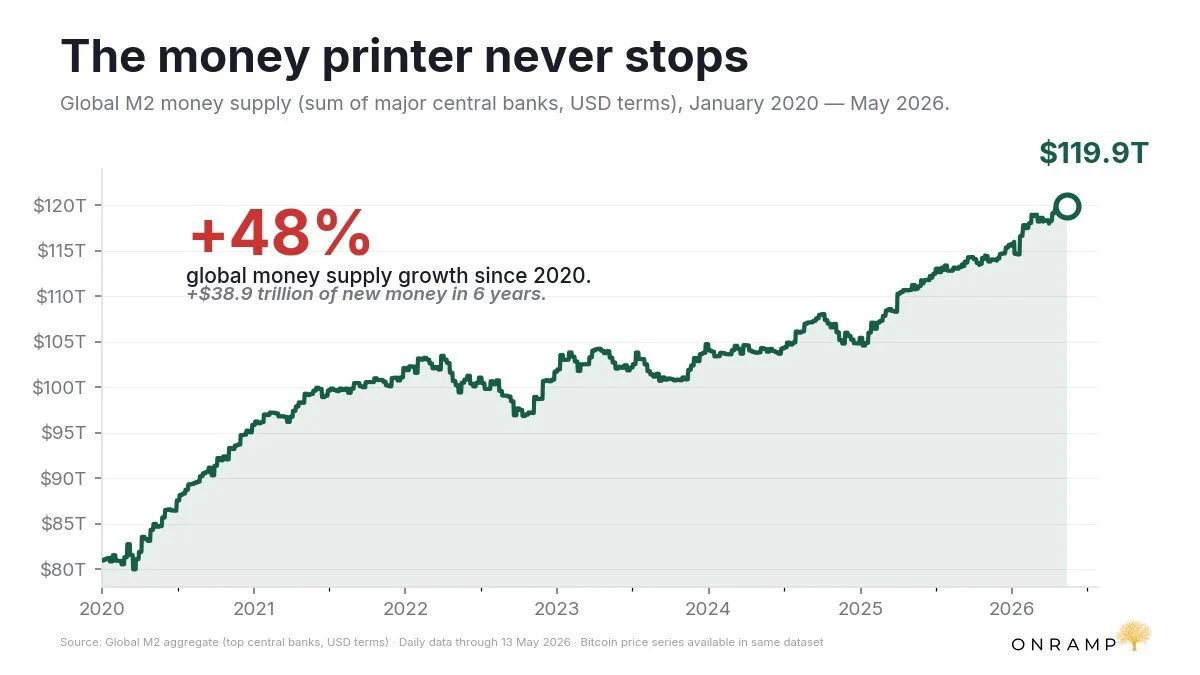
Global M2 hit $119.9 trillion in May 2026, up 48% since 2020 and $38.9 trillion larger than it was six years ago. The 2022-2023 tightening cycle looked like a turning point, but the total money supply is back at all-time highs. Central banks collectively expanded the money supply more in the six years since COVID than in the prior several decades combined, and there is no credible political path toward meaningful reversal. At the same time, spot ETFs have crossed $100 billion in AUM, wirehouses are allocating, and sovereigns are filing 13Fs with bitcoin exposure. The supply of money keeps growing. The supply of bitcoin does not.
Early Riders is the first bitcoin-denominated venture firm, raising, holding, investing, and returning capital in bitcoin. Learn more about how to get involved www.earlyriders.com.
Make sure to keep up with all our research at earlyriders.com/research.