

Early Riders | Open Range Weekly | 05.10.26
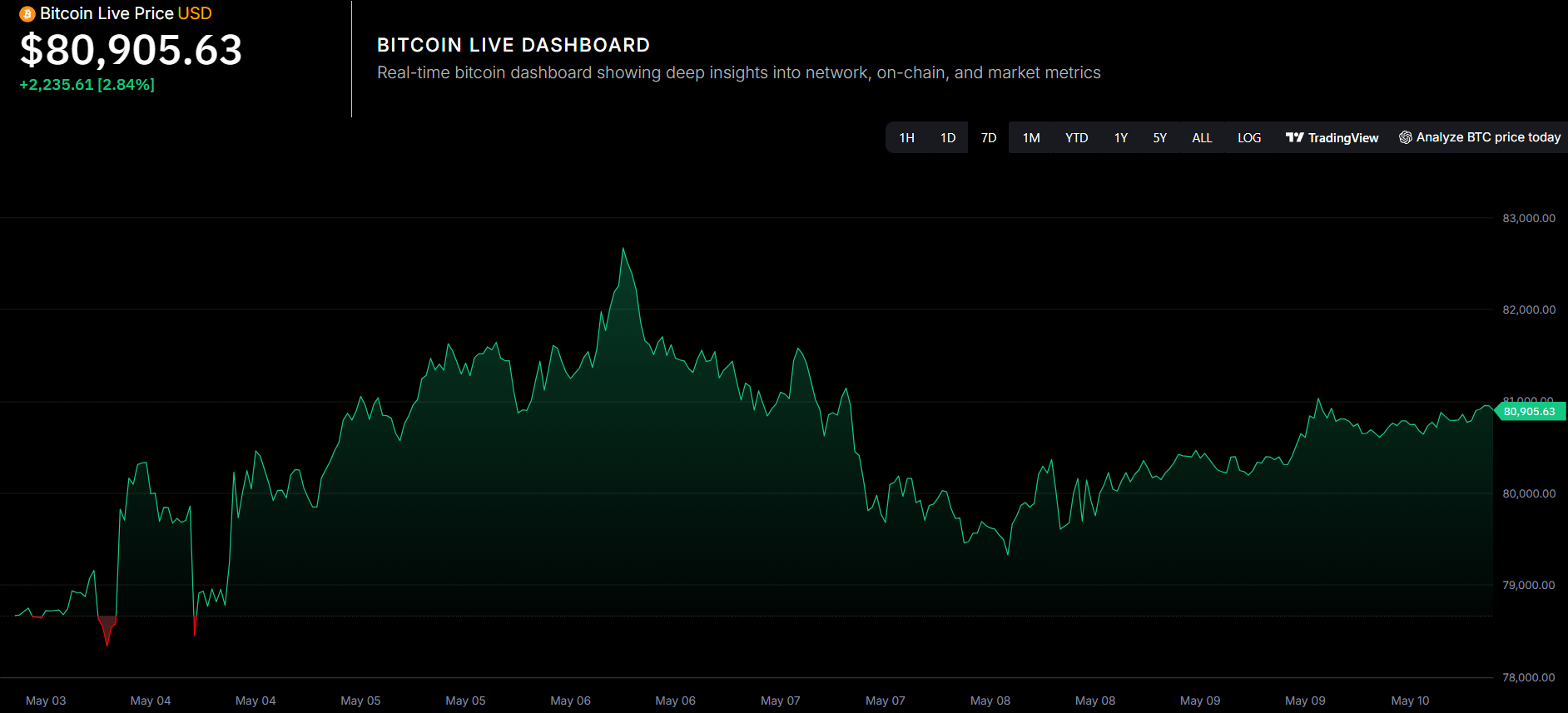
Bitcoin was up 2.8% this week to a market capitalization of $1.62T.
Early Riders Media
On this week's podcast, the team unpacked the Clarity Act breakthrough and what it means for institutional adoption, walked through Stripe's 288 product launches, contrasted Lightspark's Bitcoin-native payment network with Stripe's approach, and discussed Kraken's $25M custody fraud lawsuit alongside Block's BitKey wallet and proof of reserves.
You can find all our episodes on our podcast website as well as listen on YouTube, Apple, and Spotify.
Industry & Institutional Updates
Morgan Stanley launched digital asset trading on E*Trade at 50 basis points per transaction, undercutting Coinbase and Charles Schwab.
Kraken announced its acquisition of Reap Technologies for $600M to accelerate stablecoin payments across Asia, Africa, and emerging markets.
Core Scientific announced plans to expand its Muskogee, Oklahoma campus to 1.5 GW through a new acquisition and 250 acres of land.
a16z raised $2.2B for its fifth digital asset fund to back founders building stablecoins, onchain finance, and AI agent infrastructure into everyday products.
Coinbase cut headcount by 14%, with CEO Brian Armstrong citing AI acceleration as the reason for the reduction.
Strategy reported a $12.5B Q1 net loss on Bitcoin fair value accounting, while achieving 9.4% BTC Yield year-to-date on 818,334 Bitcoin worth $64B.
Coinbase posted a $394M Q1 net loss but hit an all-time high 8.6% global crypto trading market share, up 5x since Q1 2023.
Core Scientific reported $115M in Q1 revenue, up 45%, as AI colocation revenue from CoreWeave surged from $8.6M to $77.5M with 243 MW fully billing.
American Bitcoin mined a record 817 BTC in Q1 at $36,200 per coin, a 23% efficiency improvement, while growing its treasury 30% to 7,021 Bitcoin.
Hut 8 reported $71M in Q1 revenue, up 226% year-over-year, locking in $16.8B in contracted AI data center lease revenue across two hyperscale campuses.
a16z raised $2.2B for its fifth digital asset fund to back founders building stablecoins, onchain finance, and AI agent infrastructure into everyday products.
Bullish agreed to acquire UK registrar Equiniti for $4.2B to expand into tokenized securities and stablecoin settlement.
Sygnum partnered with FalconX to bridge regulated banking infrastructure with on-chain tokenized credit for institutional clients.
BNY announced a strategic collaboration with Finstreet and ADI Foundation to deliver digital asset infrastructure in the UAE.
Amazon introduced Bedrock AgentCore payments built with Coinbase and Stripe, enabling AI agents to transact autonomously online.
Galoy expanded its Bitcoin-native banking platform to help US banks and credit unions add lending, payments, and custody.
Tether posted $1.04B in Q1 profit and a record $8.23B reserve buffer backed by $141B in US Treasuries.
Western Union launched USDPT on Solana, advancing regulated digital payment infrastructure for global money transfers.
Rain became a Mastercard Principal Member, enabling credit and prepaid cards for partners building stablecoin payment programs.
MoonPay launched MoonAgents Card, a virtual Mastercard that lets AI agents spend stablecoin balances anywhere Mastercard is accepted.
Strive crossed 15,000 BTC in its treasury after purchasing 444 bitcoin for $33.9M at an average price of $76,307.
Sequans sold half its Bitcoin treasury as the French chipmaker retreats from the corporate Bitcoin accumulation trend.
What We're Watching: The Push & Pull of Deflation & The Right Denominator
AI is Deflationary. The Money Supply Isn't.
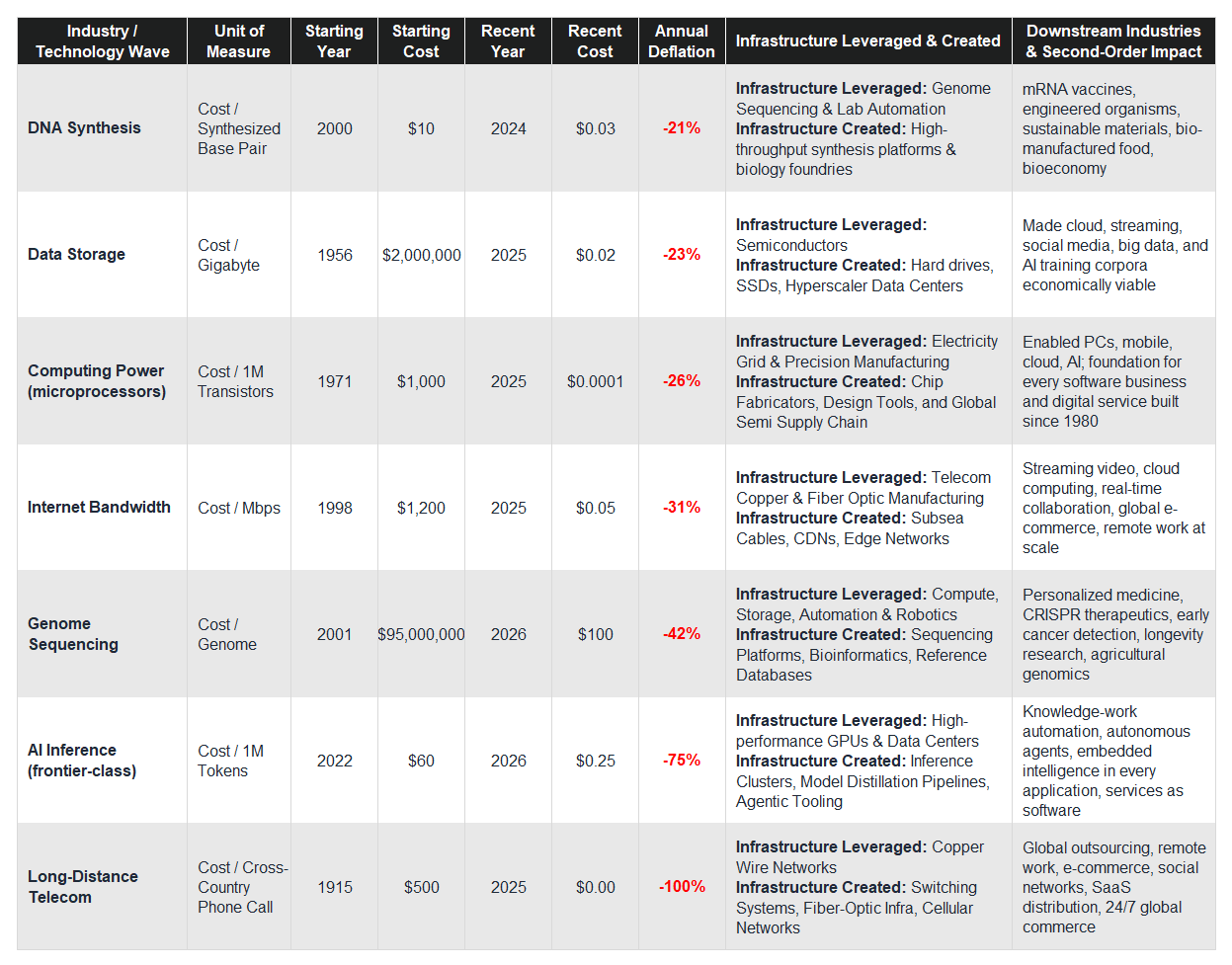
The technology stack is driving deflation at 6 percent or more annually across manufacturing, logistics, healthcare, and professional services. The Federal Reserve targets 2 percent inflation. The arithmetic between those two numbers is not an accident or a rounding error; it is a structural feature of the system as currently designed. Closing the gap requires roughly 7 percent annual money supply expansion just to hold the consumer price index at its mandated level, which means the purchasing power of dollar-denominated savings is being systematically diluted by the same monetary machinery that claims to be protecting it. Every wave of AI-driven efficiency compounds the prior one and arrives faster than the last, so the deflationary pressure is accelerating while the monetary response required to offset it is also accelerating.
The fiscal position removes any possibility of a more disciplined response. At 130 percent debt-to-GDP, the United States has no credible political path toward spending discipline, and the evidence was provided clearly by the Department of Government Efficiency, which demonstrated that even a mandate explicitly aimed at structural reduction produced no meaningful change to the trajectory. The debt must be continuously rolled over and financed by a monetary base that dilutes the purchasing power of every dollar in circulation. Interest expense now consumes 14 percent of the federal budget at current Treasury yields, and that figure is rising. The only remaining option for a government that will not cut spending or raise taxes sufficiently is to inflate the debt away, which is precisely what M2 expansion has been doing since 2020 at a pace that is now structurally locked in.
The Asymmetry Nobody Talks About
The deflationary gains from technology do not show up where people need them most. Cellphone service has declined 45 percent in cost since 2000. Hospital services are up 296 percent. College tuition is up 199 percent. The assets that represent the bulk of household wealth creation, housing, healthcare, and education, have compounded at rates that outpace wage growth by a widening margin every year, while the productivity benefits from AI flow primarily to those with access to computational capital and appreciating assets. Younger generations without assets are not experiencing a deflationary technology boom; they are experiencing the inflation of every input required to build a life, while watching nominal wealth accumulate in accounts that measure the wrong thing. The technology that should be closing the divergence is accelerating it.
Gold Moves First, Bitcoin Follows
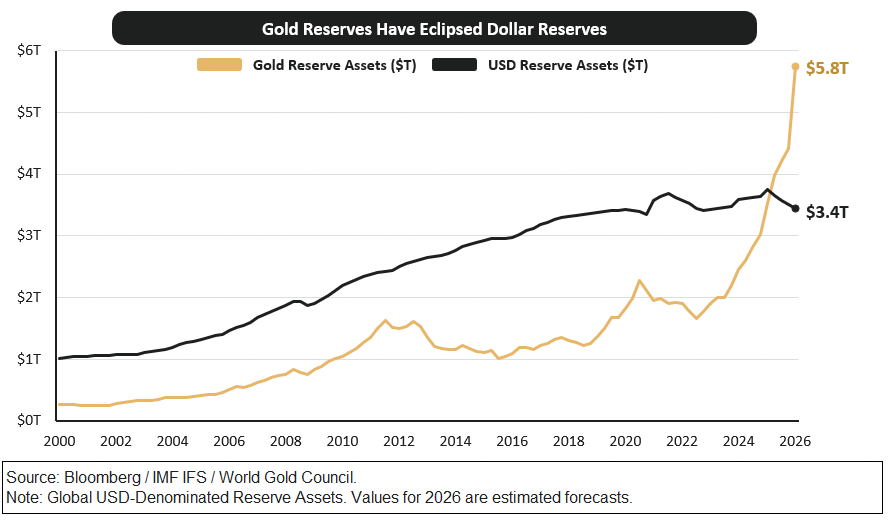
The sovereign response to dollar erosion is already visible in the reserve allocation data. Global central banks across Asia, the Middle East, and Latin America have been diversifying out of Treasuries since the United States seized Russian reserve assets in 2022, which settled a long-standing question about counterparty risk at the sovereign level: any asset held within reach of U.S. jurisdiction is subject to seizure regardless of the legal framework that nominally protects it. The first instinct has been gold, the asset central bankers understand and the one with millennia of precedent and no institutional learning curve. Global gold reserves have now eclipsed dollar reserves at $5.8 trillion versus $3.4 trillion, and that reallocation is still early. Bitcoin is not yet large enough for major central banks to take meaningful positions, but gold and bitcoin share the same fundamental properties that make them the most attractive reserve assets: both are scarce, both exist outside the liability structure of any single government, and both hedge against the currency debasement that monetary authorities are being forced to execute. The rise in gold at the sovereign level validates the hard money thesis for the entire institutional spectrum watching it play out.
Stablecoins as the Accelerant
The United States is pursuing dollar-denominated stablecoins as a strategic instrument to extend dollar dominance through digital rails, which creates an infrastructure dynamic that works against the dollar's long-run position even while serving its short-term interests. Every dollar-backed stablecoin in circulation is collateralized by Treasury bills, generating a synthetic demand base for U.S. government debt that grows automatically as stablecoin adoption widens. The rails being constructed for that adoption, wallets, exchanges, on-ramps, off-ramps, payment processors, and settlement networks, are nearly identical to the infrastructure required for bitcoin. As populations in Nigeria, Argentina, and Turkey that initially adopted stablecoins as a better local alternative begin to experience the same inflationary pressure in housing, food, and energy that erodes every fiat currency, the question they will increasingly ask is why they are holding a digital version of a currency that still loses purchasing power every year. Bitcoin's declining volatility through broader market adoption makes the answer increasingly legible.
Smart Money Is Moving
The institutional internalization of scarcity is now visible in product launches rather than white papers. BlackRock's IBIT reached $97 billion in assets under management by early 2026, the fastest-growing ETF ever launched. Morgan Stanley became the first major U.S. bank to issue a proprietary spot bitcoin ETF, listing the Morgan Stanley Bitcoin Trust on NYSE Arca at 14 basis points, which is 11 basis points below IBIT and the lowest fee on the market. With roughly 16,000 Morgan Stanley financial advisors overseeing $6.2 trillion in client assets now distributing a bitcoin product carrying the bank's own name, the distribution infrastructure has shifted from fintech-native issuers to the core of traditional Wall Street. This is not a fintech story about apps competing with banks; it is a story about the largest financial institutions on the planet repricing monetary premium from a denominator with infinite supply to one where scarcity is enforced by mathematics. The divide this transition creates will compound over decades. Those who choose the right denominator will find their wealth reflects the real productivity gains created by AI. Those who remain in the wrong one will watch nominal wealth grow on paper while real purchasing power erodes beneath it.
To learn more, view the full research piece available here.
Chart of the Week
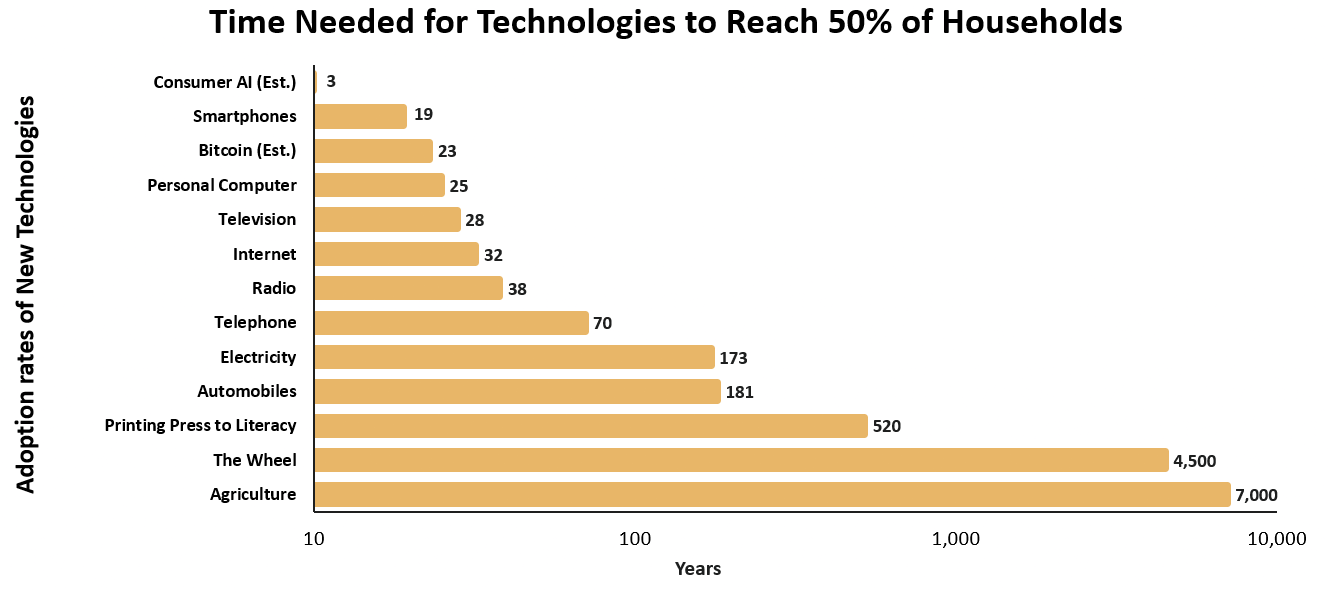
Bitcoin is expected to reach 50% household adoption faster than electricity, the telephone, and the internet, at just 23 years. It is tracking as one of the fastest-adopted technologies in history. The same infrastructure compression that took Consumer AI from zero to 50% penetration in 3 years is now accelerating bitcoin's second wave, which means the window for early positioning is shorter than any prior technology cycle has been.
Early Riders is the first bitcoin-denominated venture firm, raising, holding, investing, and returning capital in bitcoin. Learn more about how to get involved www.earlyriders.com.
Make sure to keep up with all our research at earlyriders.com/research.