Preface
Bitcoin infrastructure represents a unique convergence of three powerful economic forces that create exceptional investment opportunities. Metcalfe’s Law demonstrates how Bitcoin’s network value grows exponentially with adoption, creating compounding returns for infrastructure providers who facilitate this growth. Moore’s Law ensures these providers operate with continuously declining costs while serving expanding markets. Reflexivity transforms individual adoption decisions into collective reality, where infrastructure improvements drive adoption which drives further infrastructure investment in self-reinforcing cycles.
The Bitcoin infrastructure investment thesis rests on a fundamental insight: good money drives out the bad, the total addressable market should continue to grow over time, compute costs continue to come down exponentially, and better infrastructure drives increased adoption.
Metcalfe’s Law and Network Monetary Effects
Metcalfe’s Law states that the value of a network is proportional to the square of its network participants.1 Monetary networks exhibit particularly strong network effects because money’s utility derives entirely from others’ willingness to accept it in exchange, either directly, or through secondary exchange with fiat currency usage as an intermediary good, creating pure network externalities absent in most economic goods.
Bitcoin’s monetary network encompasses multiple participant categories with distinct contributions. Individual holders provide liquidity depth and price stability through holding decisions. Merchants enable medium of exchange functionality through payment acceptance. Exchanges facilitate price discovery and conversion services. Miners provide security and transaction processing. Each participant category enhances utility for all other categories through complementary network effects.
Monetary network effects create increasing returns to adoption that distinguish Bitcoin from traditional financial assets. Each additional participant makes Bitcoin more useful for all existing participants through enhanced liquidity, and rising purchasing power. This creates positive feedback loops where adoption success attracts further adoption through demonstrated network utility rather than speculative momentum alone.
Metcalfe’s Law illuminates money’s tendency toward monopolization through network effects rather than collective belief. Individuals cannot escape the economic consequences of others adopting superior monetary standards. This network dynamic refutes characterizations of money as mere collective delusion requiring universal faith. Superior monetary properties, scarcity, durability, portability, create competitive advantages that compound through network adoption. Each additional participant enhances liquidity and purchasing power for all existing holders, creating self-reinforcing cycles independent of consensus belief. Non-participants experience relative purchasing power erosion as their monetary medium weakens against the superior alternative.
Bitcoin’s security model creates insurmountable advantages over traditional monetary systems through distributed network effects shown through Metcalfe’s Law. Fiat currency systems operate as centralized hub-and-spoke networks where a single central bank controls a limited number of subordinate commercial banks, creating what amounts to a network with minimal nodes and concentrated attack surfaces. This centralization creates systemic vulnerabilities where political interference or coercion can compromise the entire monetary system through pressure on a few key actors.
Bitcoin’s architecture represents the inverse approach: a distributed network of thousands of independently operated nodes that verify transactions without central coordination. This decentralization gains exponential strength through Proof of Work mining, which commits massive computational resources to network security. While early Bitcoin faced meaningful attack vectors, a sufficiently resourced attacker might have executed a 51% attack or compromised the limited number of node operators, network growth has significantly reduced these vulnerabilities.
Each additional node and every new gigawatt of hashpower compounds Bitcoin’s security through what can be termed “defensive network effects.” Attack costs scale exponentially with network size while attack success probability decreases proportionally, creating a security model that becomes more robust through adoption rather than more vulnerable to coordination problems. This represents Metcalfe’s Law applied to monetary sovereignty: Bitcoin’s resistance to coercion and manipulation strengthens with the square of network participants, creating a security model that traditional centralized systems cannot replicate regardless of resources deployed.Moore’s Law
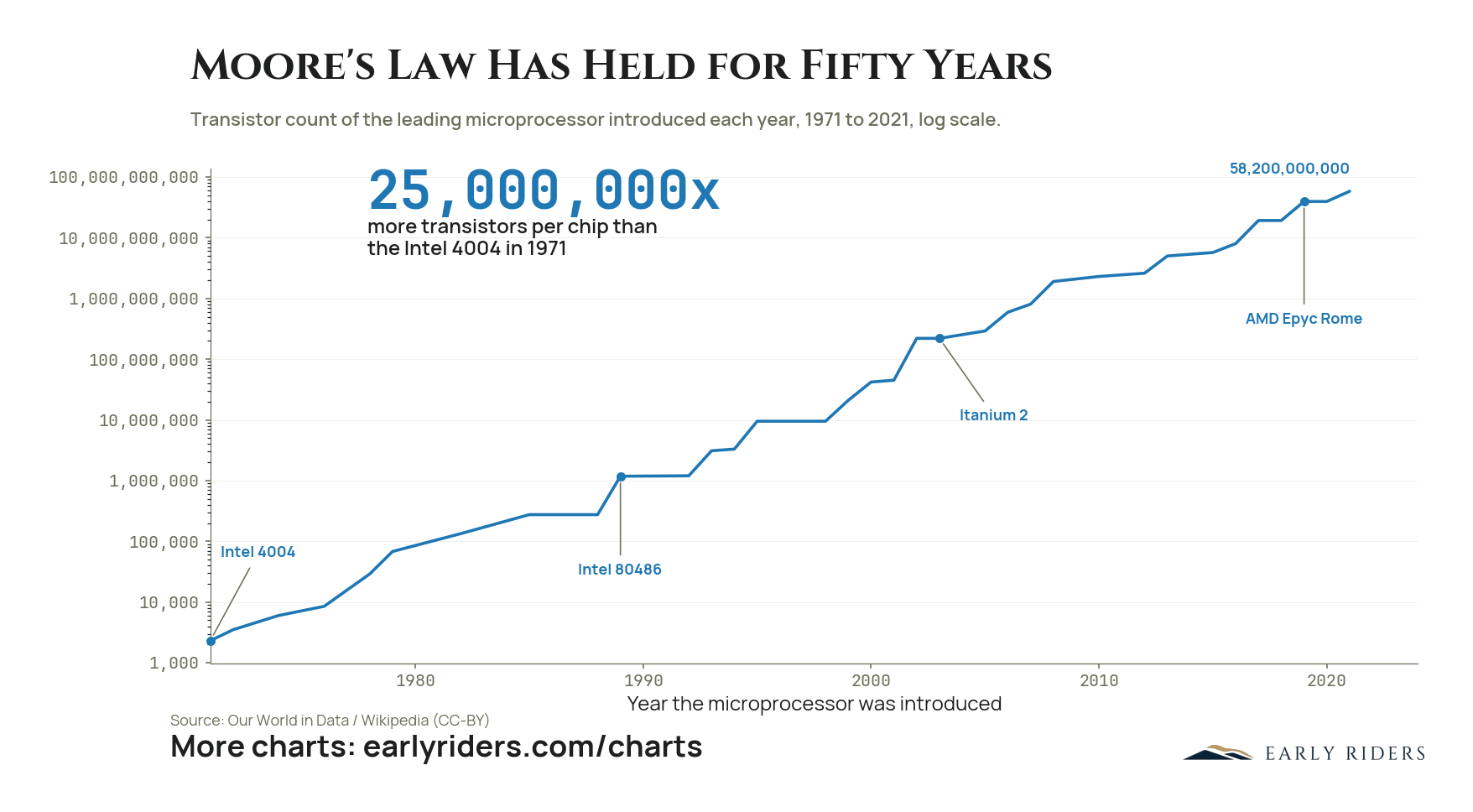
In 1965, Gordon Moore observed that the number of transistors on an integrated circuit was doubling roughly every year, a cadence he revised to about two years in 1975. The implication was exponential gains in computing power alongside falling costs.2 From 1971 to 2023, leading-edge chips scaled from roughly 2,300 transistors to about 134 billion.3,4 Those efficiency gains delivered major productivity tailwinds and, in many cases, helped offset the visible effects of substantial monetary inflation. While strict transistor-density doubling has largely stalled since the 2010s, advances such as chiplets and 3D stacking have extended a “revised” Moore’s Law, measured as compute per dollar.
For Bitcoin, Moore’s Law manifests across multiple infrastructure domains: mining hardware power efficiency, data center optimization, and operational software advancement. Bitcoin mining relies heavily on computational power to solve cryptographic puzzles for transaction validation and block creation. Moore’s Law has driven the development of more powerful and energy-efficient hardware, such as ASICs (Application-Specific Integrated Circuits), which have significantly increased the hash rate of the Bitcoin network over time. This makes mining more competitive but also more secure as the network’s computational power grows.
The exponential improvement in hardware has enabled Bitcoin nodes to handle increasing amounts of data, supporting the growth of the blockchain. More efficient processors and storage solutions allow full nodes to store and process the entire Bitcoin ledger, which grows with every transaction. As hardware becomes cheaper and more powerful, the cost of running Bitcoin nodes decreases, broadening access to Bitcoin and supporting its decentralization, and hardening its security.
For businesses operating in Bitcoin infrastructure, Moore’s Law creates profound operational leverage. Companies can either dramatically increase their service capacity using the same resources, or maintain equivalent output while reducing operational complexity and costs. This “do more with less” dynamic drives the development and proliferation of superior Bitcoin standards across the ecosystem. Custody providers can serve exponentially more institutional clients through automated security protocols and standardized reporting systems. Exchange operators can process vastly higher transaction volumes with improved reliability while reducing per-transaction operational costs. Payment processors can handle increased merchant adoption through streamlined integration standards that require minimal technical implementation.
These efficiency improvements manifest as enhanced industry standards developed and implemented by competing enterprises. Each company’s operational optimization becomes encoded in better custody practices, more efficient trading infrastructure, simplified payment integration, and standardized compliance frameworks. The resulting standards proliferation reduces adoption barriers for new market participants while enabling existing providers to scale operations efficiently.
Payment infrastructure development responded to medium of exchange adoption demand through entrepreneurial capital allocation. Early Bitcoin transactions required technical knowledge and lengthy confirmation times that limited commercial utility. Investment in payment processing, instant settlement solutions, and point-of-sale integration reduced transaction complexity while enabling broader merchant adoption. Each infrastructure improvement expanded Bitcoin’s economic utility through reduced friction and enhanced reliability.
Technological efficiency improvements follow multiple parallel tracks rather than single advancement curves. Hardware efficiency gains continue through ASIC optimization and manufacturing process improvements. Operational efficiency improves through automation and standardization of best practices. This multi-domain improvement provides continued barrier reduction without dependence on single technological constraints.
Bitcoin’s Reflexivity
George Soros defined reflexivity as the two-way interaction between participants’ thinking and the situations they participate in, where perceptions influence reality and reality shapes perceptions in continuous feedback loops.6 Bitcoin embodies this principle at its foundational level through its creator’s explicit acknowledgment of adoption-dependent value realization.
Satoshi Nakamoto recognized Bitcoin’s inherent reflexivity in his seminal observation: “It might make sense just to get some in case it catches on. If enough people think the same way, that becomes a self fulfilling prophecy.”5 This statement encapsulates the reflexive mechanism where individual rational decisions aggregate into collective adoption outcomes that validate the original economic calculations.
Bitcoin’s monetary properties emerge through market participation rather than decree. Scarcity becomes meaningful only through adoption. Store of value characteristics manifest through demonstrated holding behavior. Medium of exchange utility develops through network effects of both savings and peer to peer exchange adoption. Each property strengthens through use, creating reinforcing feedback loops between adoption expectations and realized monetary functions.
The reflexive mechanism operates through economic principles of subjective value and methodological individualism. Each market participant evaluates Bitcoin’s potential utility based on personal economic calculations and expectations of others’ adoption decisions. These individual assessments aggregate through market processes into observable price discovery and infrastructure development that either validate or refute original adoption theories.Across participant categories, corporates, institutions, and nation-states, Bitcoin adoption reflects the logical economic conclusion that an asset with absolutely fixed supply should capture value in a world of perpetually expanding fiat monetary bases, with each individual participant reaching this conclusion through independent economic calculation rather than coordinated decision-making, whether that individual is an entrepreneur, CFO, portfolio manager, or treasury official making decisions within their respective organizational contexts. However, the reflexive nature of adoption of Bitcoin across competitors drives decreasing career risk, volatility, and thus increased adoption across similar parties.
Bitcoin’s reflexive properties differ fundamentally from traditional assets through supply inelasticity. In conventional markets, rising prices typically trigger supply expansion: higher gold prices incentivize increased mining, rising real estate values spur construction, and elevated stock prices enable additional equity issuance. Bitcoin’s algorithmic supply schedule prevents this reflexive supply response, creating pure demand-driven price discovery without supply-side dilution mechanisms that normally moderate price appreciation in other asset classes.
Infrastructure Development, Reflexivity, Moore’s Law & Metcalfe’s Law
As the network of Bitcoin users grows over time, there too is a reflexive relationship between the value of the network, and the value of infrastructure development. Entrepreneurs identify unmet market needs and invest capital in solutions that enable broader Bitcoin adoption, which drives additional revenue in the infrastructure development, and thus attracts better capital solutions.
The progression of infrastructure development follows predictable patterns observable across technology adoption cycles, but with unique characteristics driven by Bitcoin’s monetary properties. Early infrastructure focused on basic functionality: exchanges to acquire Bitcoin, wallets to store it, and payment processors to spend it.
As institutional infrastructure needs evolve, the principles of Moore’s Law and Metcalfe’s Law create distinct revenue opportunities across Bitcoin infrastructure layers, each capable of growing faster than Bitcoin’s price appreciation.
Market validation comes from companies like Coinbase, whose net revenue grew roughly 13x from 2019 to 2024, tracking Bitcoin’s growth, while operating costs grew significantly slower.7,8 Private and early-stage infrastructure companies, that are able to focus on specific high-growth verticals, can demonstrate revenue growth multiples that exceed Bitcoin’s price appreciation by 2–3x, validating the compounding effects of Moore’s Law and Metcalfe’s Law on operational efficiency and network value creation.
The following infrastructure categories each exhibit these compounding dynamics, offering distinct paths to outperform Bitcoin’s base appreciation:
Trading: Technological advancements driven by Moore’s Law enable Bitcoin exchanges to process high transaction volumes with low latency, supporting high-frequency trading and real-time market analysis. Metcalfe’s Law drives trading platform value as more users join, increasing liquidity and tightening market spreads. The interconnectedness of global exchanges and trading tools further amplifies this effect, creating a more efficient and robust trading ecosystem.
Payment infrastructure: Point-of-sale integration, instant settlement, and merchant processing tools were developed through entrepreneurial investment targeting specific needs. This distributed approach generated diverse solutions addressing varied use cases. Companies like Lightspark have reduced friction for merchants and consumers, expanding Bitcoin’s economic utility.
Prime Brokerages: Prime brokerages in the Bitcoin ecosystem provide institutional clients with integrated services, including trading, lending, custody, and portfolio management. Moore’s Law supports these operations by enabling faster and more cost-effective infrastructure. High-performance computing facilitates real-time order execution, risk management, and portfolio analytics, critical for institutional trading strategies. The declining cost of computing power allows prime brokerages to offer competitive fees, making Bitcoin services more accessible to institutional clients. The value of Bitcoin prime brokerages grows exponentially with the number of institutional clients and integrated services.
Lenders: As the successes and failures of lenders with bitcoin as the collateral develops, the industry coalesces around best practices and standards, the network of bitcoin holders who are interested in taking out a loan against their bitcoin continues to grow, while the reduction of losses from lenders drives additional lenders into the space, driving down rates.The reflexive relationship of lower rates drives increased interest in bitcoin backed loans, driving increased lender side demand, while Metcalfe’s Law allows operating costs to scale less than revenue and total loans outstanding.
Custody: Moore’s Law facilitates the development of secure and cost-effective custody solutions. Advanced microchips enable hardware wallets with robust encryption and user-friendly interfaces, making self-custody and institutional custody more accessible. For institutional custodians, improved server infrastructure supports scalable, secure storage of Bitcoin, reducing costs and enhancing trust. This cost reduction creates expanding margins: as custodians charge basis points annually on AUM, their revenue grows with both Bitcoin appreciation and user adoption. A 10x increase in Bitcoin price combined with 10x growth in institutional clients creates 100x revenue growth, while Moore’s Law ensures operational costs increase sub-linearly. Metcalfe’s Law applies as the growing number of Bitcoin users increases demand for custodial services, creating a more interconnected ecosystem. As custodians integrate with exchanges and payment processors, the network’s value grows, attracting further adoption.
The evolution toward multi-institutional custody, where multiple entities collaboratively manage Bitcoin private key material is the natural evolution. Advances in chip design enable the development of high-performance, secure hardware for multi-signature wallets and cold storage solutions. These systems require complex cryptographic protocols, such as Shamir’s Secret Sharing or threshold signatures, which benefit from faster processors to execute secure key management efficiently. Improved hardware reduces the cost of maintaining geographically distributed, high-security data centers, allowing custodians to scale operations. Metcalfe’s Law applies powerfully to custody infrastructure as the growing number of Bitcoin users increases demand for custodial services, creating a more interconnected ecosystem. As custodians integrate with exchanges and payment processors, the network’s value grows, attracting further adoption.
A larger network of custodians standardizes security protocols and interoperability, enabling seamless asset transfers between institutions, exchanges, and lending platforms without centralized control of the asset.
For example, a multi-institutional custody framework that integrates with prime brokerages or payment processors enhances Bitcoin’s utility for institutional investors, attracting more participants. As more hedge funds, family offices, and corporations engage with prime brokerages, liquidity in Bitcoin markets increases, tightening spreads and improving price stability. This attracts additional participants, creating a virtuous cycle consistent with Metcalfe’s Law. Furthermore, prime brokerages that connect custody, trading, and lending services into a unified platform amplify network value. For instance, a prime brokerage that allows clients to custody Bitcoin, trade it on multiple exchanges, and borrow against it creates a highly interconnected ecosystem. The growing adoption of Bitcoin by institutional players, including through partnerships with traditional financial institutions, further enhances the network’s value, positioning prime brokerages as critical hubs in Bitcoin’s financial infrastructure.
The synergy of Moore’s Law and Metcalfe’s Law creates a powerful dynamic for Bitcoin and its infrastructure. Technological advancements lower costs and improve scalability, enabling custody, trading, and lending platforms to handle growing demand. Simultaneously, network effects increase the value of these systems as user adoption expands, fostering liquidity, trust, and interoperability. This feedback loop, where technological efficiency attracts users, and user growth drives demand for better technology, positions Bitcoin’s infrastructure as a cornerstone of decentralized finance.
The investment dynamics of Bitcoin infrastructure create particularly attractive opportunities. Approximately 10,000 to 11,000 major commercial banks operate globally, and each will eventually require Bitcoin capabilities to remain competitive. Yet only dozens of quality infrastructure companies exist to serve this demand.
This supply-demand imbalance drives exceptional acquisition premiums as traditional financial institutions compete to acquire proven Bitcoin infrastructure rather than building from scratch.
If the theory that Bitcoin is better money, and money tends towards monopolization is true, then every financial services provider must eventually offer the financial services catering to Bitcoin. Bitcoin infrastructure then has the significant benefits of a significantly growing total addressable market, declining operating costs with Metcalfe’s law, and a growing list of potential acquirers.
Bitcoin’s infrastructure presents a compelling opportunity due to the synergistic effects of Moore’s Law and Metcalfe’s Law, which drive technological scalability and network-driven value. Moore’s Law enables secure, cost-effective custody solutions with advanced hardware for multi-signature wallets and high-performance prime brokerage platforms for real-time trading and analytics. Metcalfe’s Law amplifies their value as adoption grows, with interconnected custodians, liquid brokerage markets, and expanding merchant acceptance creating a robust ecosystem that attracts more users and revenue. This infrastructure fuels a reflexive cycle: all increasing Bitcoin’s price and drawing more participants, further reinforcing network effects.Concepts Meet Practice: Custody Standards
Bitcoin has supported multi-signature authorization at the script level since the early days via OP_CHECKMULTISIG. Practical, scalable deployment began when Pay-to-Script-Hash (BIP-16) activated on April 1, 2012 (block 173,805), allowing funds to be sent to a script hash and redeemed by an m-of-n policy, dramatically simplifying multisig usage and addressability.9,10 Subsequent upgrades expanded efficiency and policy space: SegWit (P2WSH) reduced weight for complex scripts, and Taproot (BIP-340/341/342, activated November 2021) enabled Schnorr-based constructions11,12 (e.g., MuSig2) that compress multi-party control into single-signature-looking spends, improving privacy and fee efficiency. Together, these changes transformed multisig from a niche feature into a foundational control for institutional Bitcoin operations.
Cold storage is typically regarded as best practices for single custodians, after prior standards resulted in significant fund losses. Although there is some debate on Multi-Party Computation (MPC) versus multi-signature standards, the common denominator is the elimination of single-key control as an operational standard.
MPC offers a nuanced approach to custody by sharding a single cryptographic key among multiple parties. MPC differs significantly from bitcoin’s native multi-sig capabilities in that MPC solutions are generally proprietary, requiring trust in the vendor’s security practices. However, unlike bitcoin’s native multi-sig capabilities, which involves multiple distinct keys, MPC shards a single key into parts. Reconstituting the MPC shards to sign a transaction can introduce a single point of failure.
The market’s next step is standardizing multi-party control across independent firms, multi-institution custody (MIC). In MIC architectures, independent key agents (e.g., custodian(s), recovery provider, and client-designated agent) hold minority keys in a 2-of-3 (or greater) quorum so that no single entity can unilaterally move funds, aligning with emerging custody frameworks and security standards. As MIC networks grow, shared processes (key ceremonies, incident response, audit evidence, and recovery runbooks) become interoperable components rather than bespoke projects.
This shift is reflexive. Each additional exchange, broker, or custodian that adopts MIC increases counterparties and auditors’ familiarity with the playbook, compressing diligence cycles, reducing perceived operational risk, and broadening mandate eligibility, driving more flows into MIC-compatible venues. Simultaneously, protocol and tooling standards (PSBT/BIP-174; descriptors/miniscript; Taproot-enabled key aggregation) lower coordination and on-chain costs for multi-party policies. As adoption compounds, unit economics improve: fixed overhead (policy engines, audits, insurance) is amortized over a larger asset base. The result is a reinforcing loop: broader adoption → lower risk premia and frictions → higher flows → larger MIC networks → lower per-account custody cost.
Conclusion
Bitcoin infrastructure represents a unique convergence of favorable economic dynamics that create exceptional investment opportunities. Moore’s Law systematically expands addressable markets for revenue generated through the adoption of technologies. Metcalfe’s Law generates improving service quality through network effects. Reflexive adoption creates predictable demand growth across institutional and geographic segments. Network scaling enables operational efficiency gains that compound over time.
Together, these forces create what investors rarely encounter: businesses with expanding markets, decreasing costs, self-reinforcing customer acquisition, and increasing operational leverage. Unlike traditional technology investments that face market saturation and competitive commoditization, Bitcoin infrastructure benefits from economic dynamics that strengthen competitive positions as markets mature.
The investment opportunity extends beyond individual company returns to portfolio-level benefits. Bitcoin infrastructure investments provide exposure to global monetary system evolution, technology-driven efficiency gains, and network effect businesses simultaneously. This combination offers diversification benefits while maintaining exposure to transformative economic trends.
As Bitcoin transitions from experimental technology to global monetary infrastructure, the companies building supporting services will capture extraordinary value through these systematic economic advantages.
For investors seeking exposure to the digital transformation of money, Bitcoin infrastructure provides the optimal combination of growth potential, competitive advantages, and economic tailwinds that create sustainable investment returns through multiple market cycles and adoption phases.
Author: Early Riders
Sources (12)
- IEEE Spectrum Metcalfe's Law is Wrong 1 July 2006 Sources the definition: "the value of a communications network is proportional to the square of the number of its users." Worth knowing what the piece is: it states the law in order to argue it overestimates network value, proposing n log(n) instead.
- Gordon E. Moore, Electronics, vol. 38, no. 8 Cramming more components onto integrated circuits 19 April 1965 "The complexity for minimum component costs has increased at a rate of roughly a factor of two per year." The cost half of the sentence is explicit too: "by 1975 economics may dictate squeezing as many as 65,000 components on a single silicon chip", with manufacturing cost per component falling to "only a tenth of the present cost."
- Computer History Museum 1971: Microprocessor Integrates CPU Function onto a Single Chip (The Silicon Engine) Milestone year 1971 Sources the starting point: the 4004 packed "2300 transistors" into a low-cost 16-pin package. The page carries no publication date, so 1971 above is the milestone year, not a byline date.
- Apple Apple introduces M2 Ultra 5 June 2023 "M2 Ultra consists of 134 billion transistors — 20 billion more than M1 Ultra."
- Satoshi Nakamoto, Cryptography mailing list (via Satoshi Nakamoto Institute) Bitcoin v0.1 released — email 17 16 January 2009 "It might make sense just to get some in case it catches on. If enough people think the same way, that becomes a self fulfilling prophecy."
- George Soros, Journal of Economic Methodology Fallibility, Reflexivity, and the Human Uncertainty Principle 13 January 2014
- Coinbase Global, Inc. (SEC EDGAR) Annual Report on Form 10-K for the fiscal year ended December 31, 2021 Filed 25 February 2022 Supplies the 2019 base year for the revenue comparison.
- Coinbase Global, Inc. (SEC EDGAR) Annual Report on Form 10-K for the fiscal year ended December 31, 2024 Filed 13 February 2025 Net revenue grows 13.0x from 2019 to 2024 on the figures in these two filings. The unstated half of the sentence checks out as well: total operating expenses rise about 7.3x over the same span, so costs did grow materially slower than revenue.
- Bitcoin Improvement Proposals BIP-16: Pay to Script Hash Proposed 3 January 2012 "These new rules should only be applied when validating transactions in blocks with timestamps >= 1333238400 (Apr 1 2012)."
- mempool.space Bitcoin block 173,805 1 April 2012 Pins the block height in the body to the BIP-16 timestamp rule. Block 173,804 is timestamped 2012-03-31T23:58:36Z and block 173,805 is 2012-04-01T00:43:00Z, so 173,805 is the first block under the new rules.
- Bitcoin Improvement Proposals BIP-341: Taproot: SegWit version 1 spending rules Proposed 19 January 2020 "The deployment did activate at height 709632 on Bitcoin mainnet."
- mempool.space Bitcoin block 709,632 14 November 2021 Timestamped 2021-11-14T05:15:27Z, which dates the Taproot activation height to November 2021.
Subscribe to Keep Reading
Get the full piece, plus all the latest Early Riders research, letters, and the weekly newsletter, delivered directly to your inbox.
Subscribing is free, and this device stays unlocked once you do.