

Early Riders | Open Range Weekly | 03.15.26
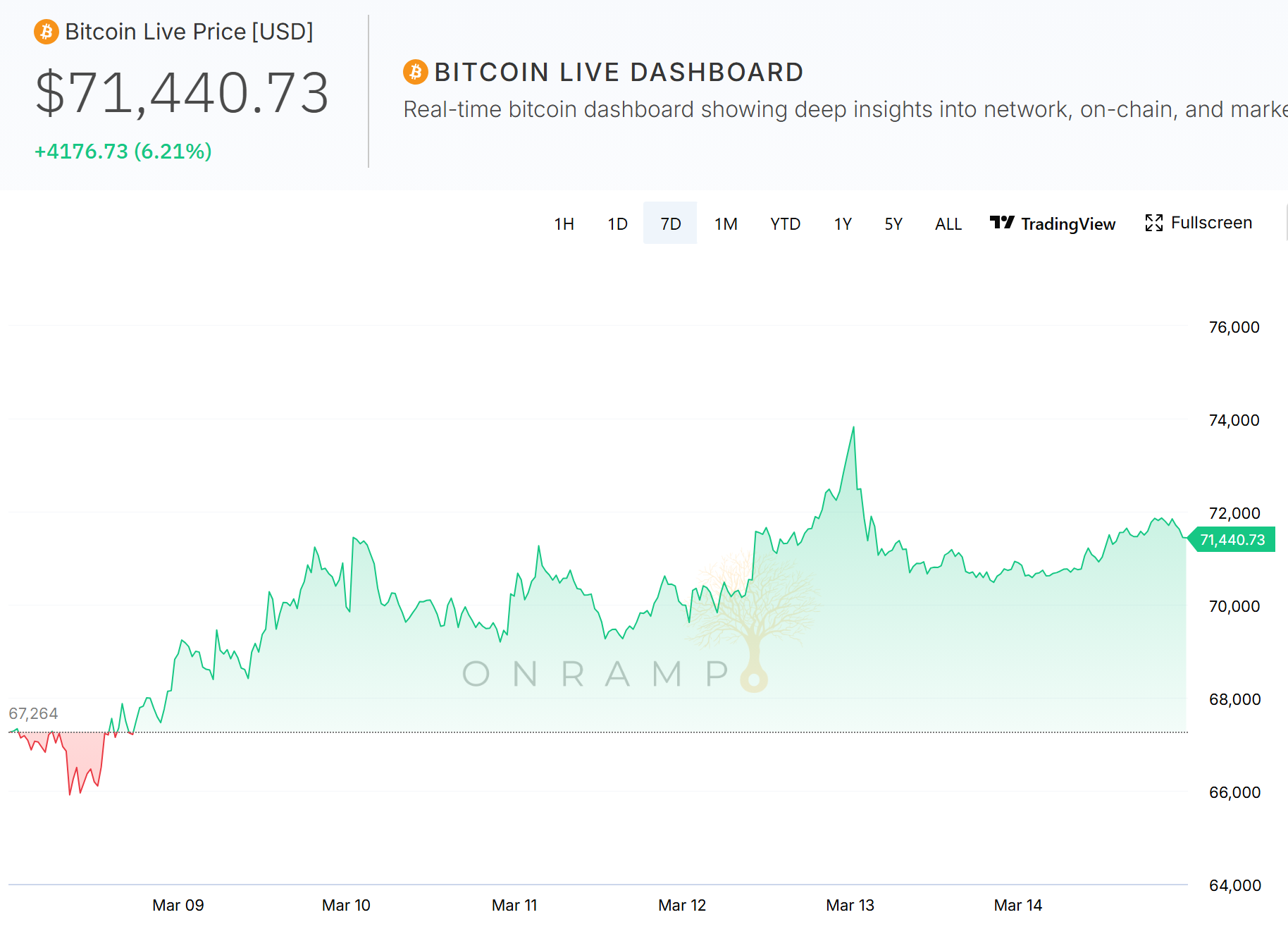
Bitcoin was up 6.2% this week to a market capitalization of $1.43T.
Early Riders Media
On this week's podcast, the team spoke with Mauricio Di Bartolomeo, the co-founder and CSO of Ledn, about the state of the bitcoin lending market, its recent investment grade asset backed loan securitization, and the future of the bitcoin lending market.
You can find all our episodes on our podcast website as well as listen on YouTube, Apple, and Spotify.
Industry & Institutional Updates
Kraken's recent SPAC seeks digital asset infrastructure targets valued up to $10B after raising $345M via its IPO.
Mastercard launched its Crypto Partner Program with 85+ companies including Binance, Ripple, PayPal, Circle, and Gemini, to connect blockchain payments with traditional rails across 200+ countries.
Strategy purchased another ~$1.3B in Bitcoin while raising nearly $377M through preferred shares, bringing its total holdings to almost 740,000 bitcoin.
MoonPay introduced Ledger-secured AI digital asset agents addressing wallet key management risks for autonomous transactions.
Ark Labs raised $5.2M backed by Tether, Anchorage, and Ego Death Capital, to further its development of bitcoin and stablecoin payments.
Utexo raised $7.5M from Tether, BigBrainVC, and Portal Ventures to build USDT natively on top of Bitcoin payment rails.
Metaplanet expanded its focus to investing in digital asset infrastructure with the allocation of around $27M to the firm's new subsidiary, Metaplanet Ventures.
Regulatory Updates
The U.S. Senate voted on a housing bill that included a section at the end that would not allow the Federal Reserve to issue CBDCs until at least 2030.
U.K. fintech Revolut gained a full-scale U.K. banking license after a three-year application process, expanding digital asset-friendly banking services in the region.
Both HSBC and Standard Chartered were the first to receive Hong Kong stablecoin sandbox approval, positioning major banks for regulated digital currency issuance in the region.
What We're Watching
Oil, War, and the Case for Scarce Assets:
Global shipping and logistics through the Strait of Hormuz have effectively ground to a halt as geopolitical tensions escalate in the Middle East, forcing the U.S. to deploy significant military resources to secure critical trade routes for oil. The U.S. has already spent over $11 billion on military operations related to Iran in the first week of the conflict, with costs accelerating as logistical support intensifies. The administration may request up to an additional $50 billion if required as the war continues. This mounting fiscal pressure comes at a time when the U.S. is already grappling with a $36 trillion national debt and persistent budget deficits.
The inevitable response will be the same: monetary expansion through the printing press. Governments facing wartime costs rarely choose austerity, and the current administration faces little appetite for spending cuts or tax increases to fund Middle East operations. As the Federal Reserve accommodates swelling defense budgets and fiscal deficits, each dollar printed continues to dilute the purchasing power of existing dollars. This currency debasement is an observable reality, with gas prices rising nearly $0.50 per gallon in response to oil rising over 50% since the start of the conflict. Both investors and individuals need scarce and finite assets that remain strong in response to never-ending monetary debasement.
Bitcoin's fixed supply of 21 million coins stands in stark contrast to fiat currencies that expand to fund military campaigns, pandemic relief, bank bailouts, and every other government priority. While policymakers print dollars to finance geopolitical conflicts, Bitcoin holders benefit from an asset whose monetary policy cannot be altered by any government, central bank, or wartime emergency. In an era where fiscal discipline takes a back seat to political agendas, scarce and finite assets like Bitcoin become essential long-term stores of value as the dollar's purchasing power erodes under the weight of unlimited printing.
For investors and institutions looking beyond the next quarter, wars are expensive, printing is inevitable, and scarcity is valuable. The U.S. military's open-ended commitment to Middle East operations virtually guarantees continued monetary expansion regardless of which party controls Congress or the White House. As traditional safe havens like bonds offer negative real yields in inflationary environments and gold faces storage and transportation challenges, Bitcoin's digital scarcity, portability, and resistance to confiscation position it as the premier hard asset for a world where geopolitical instability drives perpetual currency debasement.
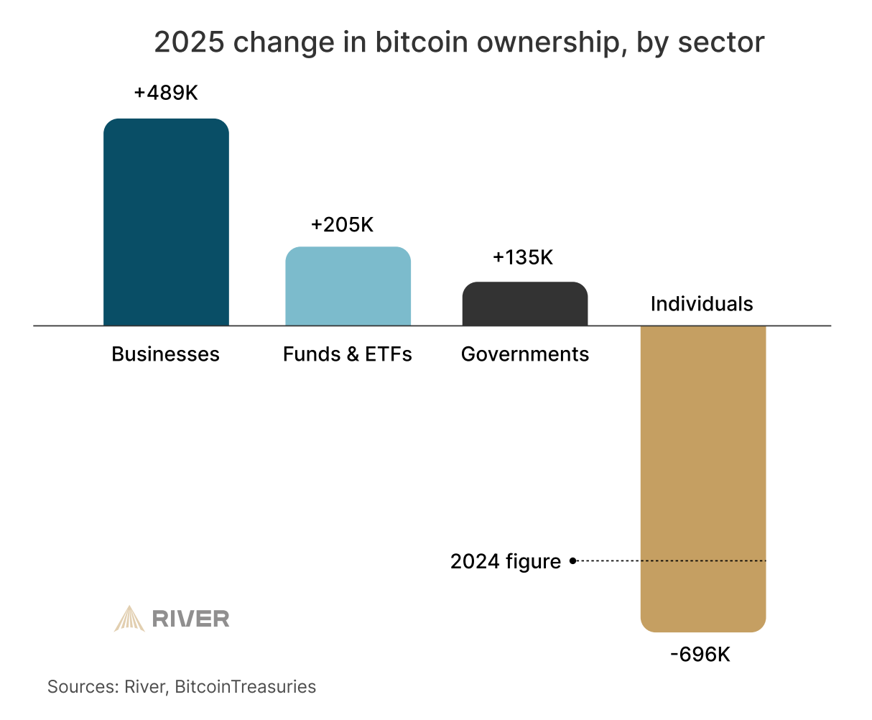
Chart of the Week
Institutional bitcoin ownership grew by 829K bitcoin in 2025, while individual holdings declined by 696K bitcoin, marking the largest wealth transfer from individuals to institutions in the asset's history.
The institutional accumulation of nearly 830K bitcoin in a single year represents roughly 4% of Bitcoin's total supply shifting from individual holders to corporate treasuries, investment funds, and sovereign governments.
Michael Saylor's "Strategy" acquired over 200K bitcoin in 2025, representing almost half of the purchases made by businesses in the period.
Find this valuable? Please forward this to someone in your network who may find benefit from the information.
Early Riders is the first bitcoin-denominated venture firm, raising, holding, investing, and returning capital in bitcoin. Learn more about how to get involved www.earlyriders.com.
Make sure to keep up with all our research at earlyriders.com/research.