The Head of Claude Code On Doing More With Less

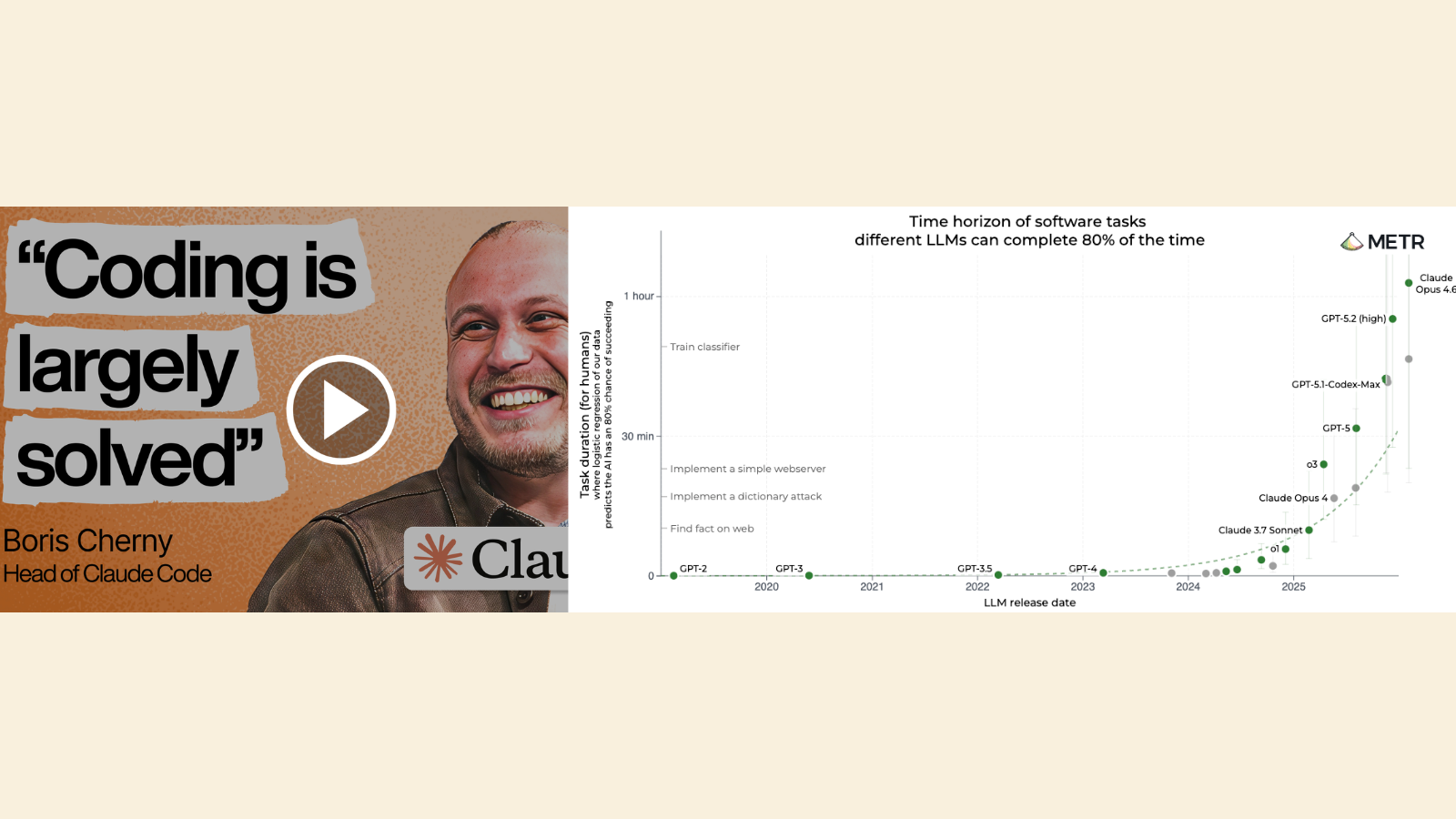
Boris Cherny runs Claude Code at Anthropic. The product now authors 4% of all public GitHub commits worldwide.
Last week, Boris sat down with Lenny Rachitsky for a long-form conversation about the state of AI-driven software development. Almost every operational insight he shared maps directly to the acceleration of doing more with less.
The Underfunding Principle
Claude Code started as a solo project. Boris joined Anthropic, spent a month hacking on prototypes, spent another month in post-training research to understand the models from the inside, then started building what would become Claude Code completely alone and without a roadmap. When he announced it internally it only received two likes.
He built it in a terminal because he was one person and it was the easiest thing to ship. The constraint of being under-resourced forced the simplest, most adaptable architecture, which ended up winning.
Anthropic now runs this as an explicit operating principle. They deliberately under-resource projects at inception. One engineer per initiative. Not because they can't staff it, because the constraint is the point.
"If you hire great engineers, they'll figure out how to do it…especially if you empower them to do it."
In practice engineers lean harder on AI tooling to help them accomplish goals faster, and automate everything possible. Boris now ships 10 to 30 pull requests per day. Every line written by Claude Code. He hasn't manually edited code since November 2025.
One person built the product that now authors 4% of all code on GitHub. That same person now ships thirty PRs a day without writing a single line by hand.
From a Few Pts. to 200% Efficiency Gains
Here's a data point that should reframe how every operator thinks about headcount planning. Over the past year, Anthropic roughly 4x'd its engineering team. In that same window, productivity per engineer increased 200%.
Boris spent a previous life at Meta, where he owned code quality across Facebook, Instagram, and WhatsApp. In that world, hundreds of engineers working on developer productivity tooling would yield gains of "a few percentage points" per year.
Structural efficiency gains allow for significant product improvements while costs hold static or decline.
Cowork: Built in 10 Days
Anthropic's Cowork product was built in 10 days by a small team using Claude Code. It shipped with a full virtual machine, a sophisticated security sandbox, and guardrails for safe autonomous operation. It was immediately a hit, growing faster in its first weeks than Claude Code did at launch.
Boris uses it for all of his team's project management. A single prompt handles weekly status collection: Cowork reads the team spreadsheet, identifies who hasn't filed their update, messages each person on Slack, and follows up. No human coordination required.
He also uses it to pay parking tickets, cancel subscriptions, respond to emails, and manage cross-tool workflows between spreadsheets, Slack, and email.
The tools are improving exponentially, which is how a product built in ten days was an immediate hit used by millions. This is what a lean, high-output operation looks like when infrastructure costs approach zero and AI agents replace coordination overhead.
Everyone is a Generalist
On the Claude Code team, every position codes, even designers, PMs, managers, finance, and data scientists.
Boris's prediction: "I think by the end of the year, everyone's going to be a product manager and everyone codes."
In reality this just means more output per person with reduced operational overhead that comes with handoffs, alignment meetings, and cross-functional coordination. A single person can do it all now.
Everyone on the roster can produce across multiple surfaces, reducing friction and increasing leverage. Entrepreneurial firms have a significant advantage, which is driving the maximum contribution per seat.
Move to Where the Puck is Headed
Boris's final piece of advice to builders carries a hidden strategic insight.
"From the very beginning, we bet on building for the model six months from now, not for the model of today."
Claude Code's early versions weren't impressive, but the trend was clear. The model wrote maybe 20% of Boris's code in February 2025, 30% by May, and then 100% by November. The product was always designed with that in mind.
The teams and companies building and investing where the world is going will capture the efficiency gains first. The ones that wait for certainty will find themselves rebuilding from behind.
Operators who are structurally lean enough to adapt when the curve inflects and understand where the trend is headed will be at a significant advantage.
The Do More With Less Thesis
Early Riders has been writing about this for almost two years.
The declining ratio of workers per $1M in revenue. The structural advantage of lean teams and the discipline of building operations where every dollar and every person produces outsized returns. The next generation of enduring companies won't be the ones that raised the most or hired the fastest, as that is likely a disadvantage in this new venture landscape.
Boris Cherny didn't reference any of this. He was just describing how his team works. How Anthropic operates. What he sees happening across the industry.
But what he described, underfunded teams shipping at 200% productivity gains, token budgets replacing headcount, products built in 10 days by small squads, role boundaries dissolving, a single engineer producing what entire departments used to is the Do More With Less thesis, at the frontier.
The firms that recognize this shift and invest accordingly aren't predicting the future, they’re operating at the new status quo. Early Riders is investing in them as part of our core thesis.
To learn more about how Early Riders utilizes this thesis as part of our investment framework read our “Do More With Less” research piece below.